Welcome to the International Institute of Tropical Agriculture Research Repository
IITA Bibliography System: Recent submissions
Now showing items 1221-1240 of 8125
-
Impact of intensive youth participation in agriculture on rural households' revenue: evidence from rice farming households in Nigeria
(2022)he youth unemployment situation is an essential component of the current agricultural policy agenda of the Federal Government of Nigeria. Deep-rooted debates on finding a lasting solution to this problem using agriculture have been targeted as one of the panaceas. Using data from 207 systematically selected rice-producing households, this study employed the Propensity Score Matching method (PSM) and the Inverse Probability Weighted Regression Adjustment method (IPWRA) to examine the effect of ... -
Assessment of the yam landraces (Dioscorea spp.) of DR Congo for reactions to pathological diseases, yield potential, and tuber quality characteristics
(2022)Yams (Dioscorea spp.) possess the potential to contribute to food security and poverty alleviation in DR Congo; however, yam production is limited by several constraints, including the lack of yam improvement programs to address challenges relating to yield improvement, resistance to foliar diseases, and post-harvest tuber quality. Identification of a superior genotype for these traits and reservoirs of genes for improvement would guide yams’ improvement. This study aims to evaluate and identify ... -
Nutrient inputs for rehabilitation of non-responsive soils in the guinea and sudan savannah agroecological zones of Ghana: Impact on grain yield and soil quality
(2022)Studies have shown that the continuous application of N, P, and K fertilizers has led to the depletion of secondary and micronutrients, which have become limiting nutrients hindering crop growth and yield. An on-farm trial was conducted to determine the effect of site-specific nutrient fertilizers and compost on soybean yield, phosphorus use efficiency, and soil properties, at Nyong Guma, Serekpere, Daffiama Saapare, and Naaga in northern Ghana. Nine (9) treatments (3 rates of mineral fertilizer ... -
Evaluation and application of the CROPGRO-soybean model for determining optimum sowing windows of soybean in the Nigeria savannas
(2022)Soybean production is limited by poor soil fertility and unstable rainfall due to climate variability in the Nigeria savannas. There is a decline in the amount and duration of rainfall as one moves from the south to north of the savanna zones. The use of adapted soybean varieties and optimum sowing windows are avenues to increase productivity in the face of climate variability. Crop simulation models can be used as tools for the evaluation of alternative management options for a particular location, ... -
Chromosome evolution and the genetic basis of agronomically important traits in greater yam
(2022)The nutrient-rich tubers of the greater yam, Dioscorea alata L., provide food and income security for millions of people around the world. Despite its global importance, however, greater yam remains an orphan crop. Here, we address this resource gap by presenting a highly contiguous chromosome-scale genome assembly of D. alata combined with a dense genetic map derived from African breeding populations. The genome sequence reveals an ancient allotetraploidization in the Dioscorea lineage, followed ... -
Integrated management of Striga gesnerioides in cowpea using resistant varieties, improved crop nutrition and rhizobium inoculants
(2022)Background Cowpea is a grain legume of major importance in sub-Saharan Africa where it is cultivated by smallholder farmers on poor soils and production is often constrained by the parasitic weed Striga gesnerioides. Method Experiments were conducted to assess the potential of rhizobium inoculation to mitigate Striga infection and increase cowpea productivity. We infested soils with S. gesnerioides and assessed the impact of treatments combining cowpea genotypes and bradyrhizobium inoculation on ... -
Guide to cowpea production in northern Nigeria
(International Institute of Tropical Agriculture, 2020) -
The economic impact of climate change on farm decisions and food consumption in Ghana
(University of Otago, 2018-05)Climate change poses a serious threat to the growth of developing countries, especially Ghana where the majority of people derive their livelihoods directly from agriculture and related industries. This thesis sets out to examine the economic impact of climate change on agriculture by modelling climate, household, and farm data from Ghana. The impact is assessed through three connected empirical studies. In our first empirical study, we estimate a multinomial logit (8,700 observations) in order ... -
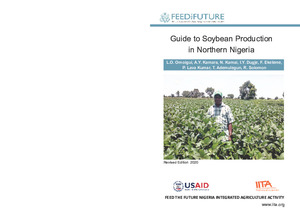
Guide to soybean production in northern Nigeria
(International Institute of Tropical Agriculture, 2020-02) -
Quantitative genetics, molecular techniques and agronomic performance of provitamin a maize in sub-Saharan Africa
(CAB International, 2020-04)This chapter focuses on quantitative genetics, screening of germplasm collection at the International Institute of Tropical Agriculture, genetic diversity, genetic variation of provitamin A content in maize. Inheritance, heritability, genotype-by-environment for carotenoid content, population improvement, development of open-pollinated varieties were also discussed. Agronomic performance, stress tolerance, combining ability, heterosis were also conducted in sub-Saharan Africa. It may be concluded ... -
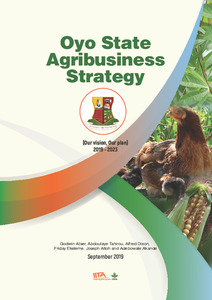
Transforming Oyo State to an Agribusiness Hub: (Our vision, Our Plan) 2019-2023
(International Institute of Tropical Agriculture, 2019-09) -
OAU/STRC & IITA. (1985). SAFGRAD - IITA Annual Report 1984. AU-SAFGRAD-IITA, Ouagadougou, Burkina Faso: (246 p.).
(AU-SAFGRAD-IITA, 1985-05) -
African nightshade and African spinach decrease root-knot nematode and potato cyst nematode soil infestation in Kenya
(2019-07)Plant-parasitic nematodes, particularly root-knot nematodes (RKN: Meloidogyne spp.) and cyst nematodes (CN: Globodera and Heterodera spp.) cause severe yield reduction in most cultivated crops and are of high economic importance. African nightshade (Solanum spp.) and African spinach (Amaranthus spp.) are important African indigenous vegetables (AIV) and are rich sources of nutrition and income. However, their host status to plant-parasitic nematodes remains largely speculative. Therefore, a survey ... -
Population dynamics of the predator Alloeocranum biannulipes Montrouzier and Signoret (Hemiptera: Reduviidae) feeding on the larger grain borer, Prostephanus truncatus (Horn) (Coleoptera: Bostrichidae), infesting cassava chips
(2020)Functional and numerical responses of adult females of the predatory bug Alloeocranum biannulipes Montrouzier and Signoret (Hemiptera: Reduviidae) to density changes of the larger grain borer, Prostephanus truncatus (Horn) (Coleoptera: Bostrichidae), infesting cassava chips were investigated under laboratory conditions. Starved predators were exposed to different prey density as treatments with 6 replicates. Numbers of prey consumed, eggs laid, and adults emerged as well as the hatching rates were ... -
Participatory exploration of the heterogeneity in household socioeconomic, food and nutrition security status for the identification of nutrition-sensitive interventions in the Rwandan Highlands
(2020)Food insecurity and malnutrition are challenges in rural Rwanda that are presumed to be affected by differential household socioeconomic status, but the relationship between food and nutrition security and socioeconomic status is not well-understood. We used a participatory and multidisciplinary study comprising nutrition survey, focus group discussion (FGD), detailed household/farm characterization, and interviews to construct a participatory household typology and to determine differences in the ... -
Land access in the development of horticultural crops in east Africa: a case study of passion fruit in Burundi, Kenya, and Rwanda
(2020)Rapid population growth in fertile agricultural lands of East Africa creates land scarcity, which has become a major hindrance to land access for the introduction of new horticultural crops. But their introduction in these areas is increasing, because of their high market price, which improves farmers’ income. As such, this research evaluated land access dynamics (availability, acquisition, and use changes) on the introduction of passion fruits in East Africa. The study used purposeful sampling ... -
Assessing the productivity of common bean in intercrop with maize across agro-ecological zones of smallholder farms in the northern highlands of Tanzania
(2020)Common bean (Phaseolus vulgaris L.) is an important grain legume for food and cash of the smallholder farmers worldwide. However, the total potential benefits to be derived from the common bean as a source of food and income, its complementarities with non-legume food crops, and significance to the environment are underexploited. Intensification of common bean could provide approaches that offer new techniques to better manage and monitor globally complex systems of sustainable food production. ... -
Resistance to aspergillus flavus and aspergillus parasiticus in almond advanced selections and cultivars and its interaction with the aflatoxin biocontrol strategy
(2022-02)Aflatoxin contamination of almond kernels, caused by Aspergillus flavus and A. parasiticus, is a severe concern for growers because of its high toxicity. In California, the global leader of almond production, aflatoxin can be managed by applying the biological control strain AF36 of A. flavus and selecting resistant cultivars. Here, we classified the almond genotypes by K-Means cluster analysis into three groups (susceptible [S], moderately susceptible [MS], or resistant [R]) based on aflatoxin ... -
Can the right composition and diversity of farmed species improve food security among smallholder farmers?
(2022)Food security and livelihoods among smallholder farmers in sub-Saharan Africa are often constrained by limited farm resource endowment. It can be difficult to improve resource endowment given barriers such as low land availability and the unaffordability of agricultural inputs, so here we ask whether farmers can gain a better return on their resources through optimizing their farm strategy in terms of the composition and/or diversity of crop and livestock species raised. Our survey of 1,133 ... -
Climate change impacts and adaptation strategies for crops in west Africa: a systematic review
(2022)Agriculture in West Africa faces the challenge of meeting the rising demand for food as national incomes and populations increase while production becomes more uncertain due to climate change. Crop production models can provide helpful information on agricultural yields under a range of climate change scenarios and on the impact of adaptation strategies. Here, we report a systematic review of the impact of climate change on the yield of major staple crops in West Africa. Unlike earlier reviews we ...