Welcome to the International Institute of Tropical Agriculture Research Repository
IITA Bibliography System: Recent submissions
Now showing items 1381-1400 of 8125
-
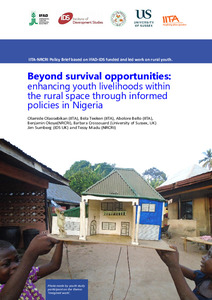
Beyond survival opportunities: enhancing youth livelihoods within the rural space through informed policies in Nigeria
(International Institute of Tropical Agriculture, 2021) -
Developing high-yielding Striga-resistant maize in sub-Saharan Africa
(2021)Striga hermonthica is a major stress of maize in sub-Saharan Africa (SSA). The International Institute of Tropical Agriculture (IITA), in collaboration with national scientists, have used team approach to investigate how best to solve the problem. Emphasis was on (i) establishing a reliable infestation technique for selecting resistant/tolerant genotypes, (ii) availability of appropriate germplasm and good sources of Striga resistance, (iii) use of appropriate breeding methods for incorporating ... -
Comparative evaluation of four different cassava peeling devices
(2021)Manual method predominates in the cassava peeling industry in Nigeria as more than 70% of the processed cassava in the market passed through manual process. Mechanical option has come to the forefront since other processing methods are discouraged based on their deficiencies. This work investigates improvements recorded with mechanical method over the manual method, and the inherent challenges of stakeholders in the industry. Three cassava peeling machines namely, BASICON, FATAROY and WAMABCO, ... -
Rice yield and economic response to micronutrient application in Tanzania
(2021-08-01)Nutrient deficiencies limit rice production in sub-Saharan Africa. The conventional recommended remedy for this is the soil application of fertilizers composed of the macro-nutrients, N, P and K, whereas crop micronutrient requirements are neglected. This leads to nutrient mining and diminished fertiliser use efficiency. Application of micronutrients along with recommended NPK fertiliser rates can prevent nutrient mining and boost rice yields. In this study, we assessed the productivity and ... -
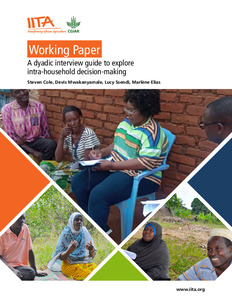
A dyadic interview guide to explore intra-household decision-making
(International Institute of Tropical Agriculture, 2021-12)Studies in the agricultural research for development literature that explore women’s involvement in decision-making within the household tend to focus their analysis on married or cohabiting couples and often consult only one spouse in a marital dyad during field interviews. These and other studies in the literature explore who makes a particular decision within the household, and more recently, inquire about the extent to which the respondent or another household member was involved in the ... -
Expansion of the cassava brown streak disease epidemic in eastern Democratic Republic of Congo
(2021-08)Cassava plays a key role in ensuring food security and generating income for smallholder farmers throughout Central Africa, particularly in the Democratic Republic of Congo (DRC). This status is threatened, however, by cassava brown streak disease (CBSD), which has expanded its incidence and range in eastern DRC. The study described here comprises the first extensive assessment of temporal change in the occurrence of CBSD and its causal viruses in DRC, based on surveys conducted during 2016 and ... -
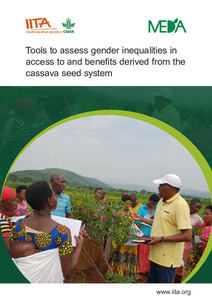
Tools to assess gender inequalities in access to and benefits derived from the cassava seed system
(International Institute of Tropical Agriculture, 2021) -
Production characteristics and strategies for adapting to the impacts of climate change on cassava whiteflies and viruses in Tanzania
(2021)Cassava is Africa’s most important food security crop and sustains about 700 million people globally. Survey interviews of 320 farmers in three regions of Tanzania to identify their production characteristics, and interviews with 20 international whitefly/virus experts were conductedto identify adaptation strategies to lessen the impacts of cassava whiteflies and viruses due to climate change in Tanzania. Structured and pre-tested interview schedules were conducted using a multistage sampling ... -
Storage root yield response to leaf harvest of improved and local cassava varieties in DR Congo
(2021)Although cassava is usually grown for its starchy roots, cassava leaves are an important vegetable and protein source in sub-Saharan countries. Eleven cassava mosaic disease (CMD) tolerant and two susceptible varieties were planted in six trials; leaves were harvested at 4, 8 and 11 months after planting (MAP) and storage roots were harvested at 12 MAP. Edible leaf and storage root dry matter yields were strongly affected by variety and interacted with location. Edible leaf yields ranged from 209 ... -
Gender barriers and success factors that shape women's involvement in and benefits from cassava seed production businesses in Tanzania
(International Institute of Tropical Agriculture, 2021-09) -
Reconciling yield gains in agronomic trials with returns under African smallholder conditions
(2020)Increased adoption of improved agricultural technologies is considered an essential step to address global poverty and hunger, and agronomic trials suggest intensification in developing countries could result in large yield gains. Yet the promise of new technologies does not always carry over from trials to real-life conditions, and diffusion of many technologies remains limited. We show how parcel and farmer selection, together with behavioural responses in agronomic trials, can explain why yield ... -
Investigating the endophytic competency and pathogenicity efficacy of Beauveria bassiana isolates against Chilo partellus Swinhoe
(2021)Sorghum bicolor L. Moench (Poaceae) is a cereal crop grown worldwide and playing an important role in human nutrition as well as feed for livestock. Lepidopteran stem borers are the most economically important insect pests that affect sorghum production and their management relies on the use of insecticide chemicals that have adverse effects on humans and biodiversity. The objective of this study was to investigate the endophytytic and pathogenic properties of Beauveria bassiana (Balsamo) Vuillemin ... -
Use of timelapse photography to determine flower opening time and pattern in banana (Musa spp.) for efficient hand pollination
(2021)Sterility and low seed set in bananas is the main challenge to their conventional genetic improvement. The first step to seed set in a banana breeding program depends on pollination at the right time to ensure effective fertilization. This study aimed at determining bract opening time (BOT) to enhance efficient pollination and seed set in bananas. A Nikon D810 digital camera was set-up to take pictures of growing banana inflorescences at five-minute intervals and time-lapse movies were developed ... -
A multi-objective model exploration of banana-canopy management and nutrient input scenarios for optimal banana-legume intercrop performance
(2021)Bananas on smallholder farmers in the African Great Lakes region are often pruned to illuminate shorter understory intercrops, reducing overall farm profitability. The impact of this practice on environmental and nutritional indicators are not known. This study determined the effect of this practice on operating profit, protein yield, soil organic matter (SOM) balance, and nitrogen input; and the management options for optimal performance of the intercrops. Alternative scenarios for improving soil ... -
Genetic improvement of cowpea for resistance to thrips (Megalurthrips sjostedti) in Mali
(University of Ghana, 2016)Several techniques, such as chemical and bio-insecticides have been applied by farmers to control thrips (Megalurothrips sjostedti) damage on cowpea. Many factors, such as improper amount of insecticides to dilute in water, cost and unavailability of insecticides and equipment limit the effective control of these thrips. Incorporating thrips resistant genes into local adapted landraces could increase farmers‘ income. These new lines could be grown with minimal insecticide application. Participatory ... -
Response of cowpea (Vigna unguiculata L.Walp) varieties to Bradyrhizobial strains (USDA 3384 and 3451) and phosphorus levels in the Sudan Savanna of Nigeria
(Bayero University, 2017-01)Field trials were conducted during the 2015 wet season at the Bayero University Kano Teaching and Research Farm (110 58’N, 8025’E and 475m above sea level) and National Institute of Horticultural Research Technology (NIHORT) Bagauda (lat. 120 08'N, long. 80 32'E, 500m above sea level). The study was conducted to determine the response of cowpea (Vigna unguiculata L. Walp) varieties to rhizobium and phosphorus levels in the sudan savannah of Nigeria. The treatments consisted of four cowpea varieties ... -
The central African soil spectral library: a new soil infrared repository and a geographical prediction analysis
(2021)Information on soil properties is crucial for soil preservation, the improvement of food security, and the provision of ecosystem services. In particular, for the African continent, spatially explicit information on soils and their ability to sustain these services is still scarce. To address data gaps, infrared spectroscopy has achieved great success as a cost-effective solution to quantify soil properties in recent decades. Here, we present a mid-infrared soil spectral library (SSL) for central ... -
Quantifying the prevalence of (non)-response to fertilizers in sub-Saharan Africa using on-farm trial data
(2021)Poor and variable crop responses to fertilizer applications constitute a production risk and may pose a barrier to fertilizer adoption in sub-Saharan Africa (SSA). Attempts to measure response variability and quantify the prevalence of non-response empirically are complicated by the fact that data from on-farm fertilizer trials generally include diverse nutrients and do not include on-site replications. The first aspect limits the extent to which different studies can be combined and compared, ... -
Small farms and development in sub‑Saharan Africa: farming for food, for income or for lack of better options?
(2021)Most food in sub-Saharan Africa is produced on small farms. Using large datasets from household surveys conducted across many countries, we find that the majority of farms are less than 1 ha, much smaller than previous estimates. Farms are larger in farming systems in drier climates. Through a detailed analysis of food self-sufficiency, food and nutrition security, and income among households from divergent farming systems in Ethiopia, Ghana, Mali, Malawi, Tanzania and Uganda, we reveal marked ...