Welcome to the International Institute of Tropical Agriculture Research Repository
IITA Bibliography System: Recent submissions
Now showing items 581-600 of 8125
-
Maize resistance to witchweed through changes in strigolactone biosynthesis
(2023-01)Maize (Zea mays) is a major staple crop in Africa, where its yield and the livelihood of millions are compromised by the parasitic witchweed Striga. Germination of Striga is induced by strigolactones exuded from maize roots into the rhizosphere. In a maize germplasm collection, we identified two strigolactones, zealactol and zealactonoic acid, which stimulate less Striga germination than the major maize strigolactone, zealactone. We then showed that a single cytochrome P450, ZmCYP706C37, catalyzes ... -
Gliricidia sepium (Jacq.) walp applications for enhancing soil fertility and crop nutritional qualities: a review
(2023-03-21)Gliricidia sepium (Jacq.) Walp is a well-known agroforestry leguminous tree that provides multiple benefits in different agroecological zones. Its apparent versatility is seen in improving animal feed, cleaning environmental wastes, and healing inflammations. It was also found to have significant benefits in agroforestry due to its ability to enhance soil fertility through nitrogen fixation and green manure. However, this article reviews the use of Gliricidia sepium to improve soil fertility and ... -
Mapping spatial distribution and geographic shifts of east African highland banana (Musa spp.) in Uganda
(2022-02-17)East African highland banana (Musa acuminata genome group AAA-EA; hereafter referred to as banana) is critical for Uganda’s food supply, hence our aim to map current distribution and to understand changes in banana production areas over the past five decades. We collected banana presence/absence data through an online survey based on high-resolution satellite images and coupled this data with independent covariates as inputs for ensemble machine learning prediction of current banana distribution. ... -
Influence of processing methods on the sensory acceptability of products from selected hybrid plantains (Musa species AAB) cultivars
(2023-02)High-yielding and disease-resistant hybrid plant cultivars recently developed by breeders need evaluation for end-use. This study evaluated the influence of processing methods on the sensory acceptability of products (plantain chips, fried ripe plantains called “dodo” in Nigeria, boiled unripe and ripe plantains, and "amala," a dough, as it is called in Nigeria when unripe and ripe plantain flour is reconstituted in hot water) from selected hybrid plantain cultivars. Pita 26, Pita 27, Mbi egome, ... -
Validation of single nucleotide polymorphism makers associated with cassava mosaic disease resistance in a clonal evaluation trial
(University of Ibadan, 2019-09)Cassava is an important staple crop in Africa for almost half of the population. The main biotic constraint of the crop is Cassava Mosaic Disease (CMD) which causes significant losses on farmers’ field. The conventional screening for CMD resistance in new cassava populations is time-consuming, expensive and not highly reliable. However, there are newly developed Single Nucleotide Polymorphism (SNP) markers linked to CMD resistance which have not been validated. Therefore, the objective of this ... -
Response of cocoa (Theobroma cacao L.) seedlings to folia fertilizer application and fertigation
(Kwame Nkrumah University of Science and Technology, 2023-03)The production of quality and vigorous seedlings is important for sustainable cocoa production. A greenhouse nursery study was conducted in 2019/2020 at CRIG to assess the effects of foliar fertilizer application and fertigation on soil chemical properties, nutrient uptake and growth of cocoa seedlings. The study was 4x3 factorial experiment, laid out in completely randomized design with 13 treatments and three replicates. Two liquid fertilizers (NPK 24:17:18 and NPK 10:10:10) and two granular ... -
Mapping social impacts of agricultural commodity trade onto the sustainable development goals
(2023-02-07)While international trade in agricultural commodities can spur economic development especially where governance is strong, there are also concerns about the local impacts of commodity production and their distribution on the environment and on people. The sustainable development goals (SDGs), though seeing trade as a means to support their achievement, recognise the need to address potential negative social and environmental impacts. It is therefore important to assess the contribution of international ... -
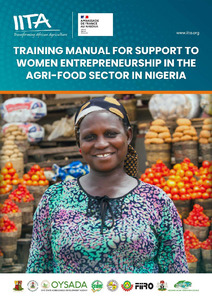
Training Manual for Support to Women Entrepreneurship in the Agri-Food Sector in Nigeria (SWEAN)
(IInternational Institute of Tropical Agriculture, 2022)The paradigm shifts from a supply-driven intervention to a more responsive demand-drive intervention necessitates the fulfillment of the sociological approach. This approach advocates that the needs of beneficiaries be ascertained before any intervention is carried out. Consequently, the training needs of women agri-preneurs were identified in Ibadan and Zaria of Oyo and Kaduna states, respectively during the inception of the Support to Women Entrepreneurship in the Agrifood sector in Nigeria ... -
Technology promotion and scaling in support of commodity value chain development in Africa
(IntechOpen, 2023-03-07)Strengthening the production and processing of key food commodities forms the basis of agricultural development in Africa. These value chains follow a quasi-linear progression across seven main segments: farm planning > land preparation and crop establishment > field production > harvest > post-harvest handling > marketing > and value addition. Each of these consists of sub-segments whose improvement depends upon promotion and adoption of specific modernizing technologies. The technologies either ... -
Impact of improved hermetic storage on food insecurity and poverty of smallholder cowpea farmers in northwestern Nigeria
(2023-12-07)Postharvest loss of cowpea grains due to insect pests like cowpea bruchids is a common problem in Nigeria and has often exacerbated the food insecurity and poverty of households. In a bid to protect their cowpea grains, farmers’ indiscriminate use of insecticides (often misused and overused) has had a negative impact on human health and the environment. Efforts to promote the use of non-chemical hermetic storage have sought to address the issue. This study, therefore, examined the impact of a ... -
Evaluation of improved cassava (Manihot esculenta Crantz) varieties and associated products for proximate, cyanogenic potential and glycemic indices
(2023-01-05)This study investigated the proximate, cyanide, and glycemic indices of roots and eba (gari dough) made from improved cassava cultivars. Twenty cassava cultivars were obtained from the IITA research farms and analyzed for proximate and carbohydrate compositions and cyanogenic potential using standard procedures. Afterward, four cassava varieties were selected using the agglomerate hierarchical cluster analysis. The selected varieties were processed into gari and reconstituted in hot water into ... -
Entrepreneurial potential and agribusiness desirability among youths in South Kivu, Democratic Republic of the Congo
(2023-01-03)In the Democratic Republic of Congo (DRC), entrepreneurship in the agriculture sector remains for youth a key pillar for income creation. However, few are attracted by agribusiness despite stakeholders’ efforts toward engaging youth in agriculture. Therefore, this study examines the relationship between entrepreneurial potential characteristics and youth desirability to start an enterprise in agriculture among 514 young people in Eastern DRC. This study revealed that youth in South Kivu have ... -
Farm production diversity, household dietary diversity, and nutrition: evidence from Uganda's national panel survey
(2022-12-16)Improved food security and nutrition remain a notable global challenge. Yet, food security and nutrition are areas of strategic importance regarding the United Nations’ Sustainable Development Goals. The increasingly weakening global food production systems pose a threat to sustainable improved food security and nutrition. Consequently, a significant population remains chronically hungry and severely malnourished. As a remedy, farm production diversity (FPD) remains a viable pathway through which ... -
Assessing cassava breeding clones in two agroecologies in the Democratic Republic of Congo
(2022-12)Breeding is the most economical approach for controlling production constraints in cassava (Manihot esculenta Crantz) smallholder farms. This study aims at assessing the performances of elite cassava clones in the province of Kwilu, Democratic Republic of Congo (DRC). Three sets of trials were established using an alpha lattice and a randomized complete block designs in two contrasting locations, upland savanna and valley forest agroecologies. Eleven traits were used in phenotyping the cassava ... -
Farmers’ preferences for east African highland cooking banana ’Matooke’ hybrids and local cultivars
(2023-03-08)Background An understanding of farmers' preferences of new banana cultivars and their characteristics is critical for developing and selecting cultivars that meet consumer needs. Therefore, phenotypic selection in a genetically variable population remains an important aspect of plant breeding. Methods The participatory varietal selection approach for preference ranking was used on 31 'Matooke' secondary and primary triploid hybrids and local banana cultivars evaluated between 2016 and 2019 in ... -
The use of mobile phones and the heterogeneity of banana farmers in Rwanda
(2022-03-29)Information and communications technologies (ICTs) play a key role in improving agricultural production, enhancing socio-ecological resilience, and mitigating rural poverty. However, the use of ICTs for agricultural development among smallholder farmers, especially in the least developed countries, still lags behind. It is therefore critical to understand distinct attitudes among heterogeneous smallholder farmers that determine use of ICTs, such as mobile phones. Moreover, data-driven empirical ... -
Circular bioeconomy in African food systems: what is the status quo? Insights from Rwanda, DRC, and Ethiopia
(2022-10-20)Increasing global food insecurity amidst a growing population and diminishing production resources renders the currently dominant linear production model insufficient to combat such challenges. Hence, a circular bioeconomy (CBE) model that ensures more conservative use of resources has become essential. Specifically, a CBE model that focuses on recycling and reusing organic waste is essential to close nutrient loops and establish more resilient rural-urban nexus food systems. However, the CBE ... -
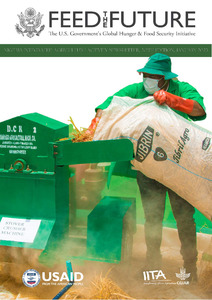
Feed the Future: Nigeria Integrated Agriculture Activity - 20th edition
(United States Agency for International Development, 2023-01) -
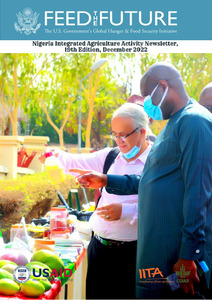
Feed the Future: Nigeria Integrated Agriculture Activity - 19th edition
(United States Agency for International Development, 2022-12) -
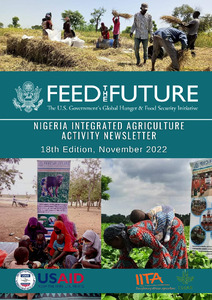
Feed the Future: Nigeria Integrated Agriculture Activity
((NIAA) Newsletter, 2022-11)