Welcome to the International Institute of Tropical Agriculture Research Repository
Reports and Documents: Recent submissions
Now showing items 261-280 of 299
-
Improving rural livelihoods in southern Africa: the SARRNET cassava component; an impact assessment report
(International Institute of Tropical Agriculture, 2010) -
Characterization of maize producing households in the Northern region of Ghana
(International Institute of Tropical Agriculture, 2010-10) -
Characterization of maize producing households in the dry Savanna of Nigeria
(International Institute of Tropical Agriculture, 2010) -
Systèmes de cultures associées à base d'igname et gestion des plantes adventices: revue bibliographique commentée
(International Institute of Tropical Agriculture, 2005) -
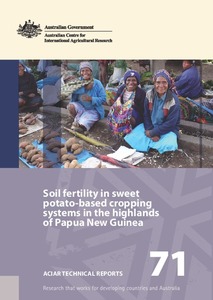
Overview of soil conservation technologies and their perception by farmers in Nigeria
(Australian Centre for International Agricultural Research, 2009)In Nigeria, West Africa, soil degradation has been one of the most critical environmental problems for along time. Hence, there has been and still is an urgent need to develop effective soil resource managementsystems that can reverse the trend. Sustaining soil productivity will enhance food security and alleviatepoverty. An extensive literature search that started in 2006 has shown that soil conservation has a longtradition, and earlier and present initiatives have resulted in various on-farm and ... -
The WASHC project stakeholder mapping & categorisation report
(West African Soil Health Consortia, 2017) -
Milestone report on the ISFM information and knowledge sharing products repository of the WASHC project
(West African Soil Health Consortia, 2017-10-06) -
The WASHC ISFM legacy database: milestone report 1.6a: develop ISFM database and ISFM data repository
(West African Soil Health Consortia, 2017-08-23) -
Cocoa seed multiplication: an assessment of seed gardens in Cameroon, Ghana and Nigeria
(International Institute of Tropical Agriculture, 2010-08) -
Costs associated with farmer field schools and video viewing clubs on cocoa integrated crop and pest management: the experience of STCP
(International Institute of Tropical Agriculture, 2011-03) -
Tropical grain legumes in Africa and South Asia: knowledge and opportunities
(International Crops Research Institute for the Semi-Arid Tropics, 2011-12) -
IITA Annual Report 2010
(International Institute of Tropical Agriculture, 2011) -
Crossing borders for IPM (The CGIAR Systemwide Program on Integrated Pest Management 2009 and 2010)
(International Institute of Tropical Agriculture, 2011) -
Baseline report of the Sudan Savanna zone of the Kano, Katsiina, Maradi (KKM) Project Learning Site (PLS) of the subSaharan AfricaChallenge Program (SSACP)
(International Institute of Tropical Agriculture, 2011) -
Characterization of maize producing communities in Benin, Ghana, Mali, and Nigeria: West Africa Regional Synthesis Report
(International Institute of Tropical Agriculture, 2011-01)Maize is becoming increasingly important as a food security crop in West Africa. However, recurring droughts constitute a continuous challenge to its production. Attempts at addressing the drought problem resulted in the conduct of a participatory community survey of maize production systems with about 20–40% probability of drought risk in four DTMA countries (Bénin Republic, Ghana, Mali, and Nigeria). The project is part of an initiative to develop and disseminate appropriate drought tolerant ... -
Study of the dynamics of resource use and identification of policy gaps in agricultural production, processing, and marketing in the Sudan Savannas of Northern Nigeria
(International Institute of Tropical Agriculture, 2011) -
Invasive floating water weeds – killing life and commerce
(International Institute of Tropical Agriculture, 2010)Weeds by definition are plants that grow in the wrong place. When their seeds or other plant parts are transported to other regions where their natural enemies are absent, they can multiply unhindered. Indigenous plants, especially those that are adapted for invading disturbed areas, can also become weeds. The first category is a particularly good target for classical biological control. Insects, mites and micro-organisms that feed on them are imported from their original area and released against ...