
Welcome to the International Institute of Tropical Agriculture Research Repository
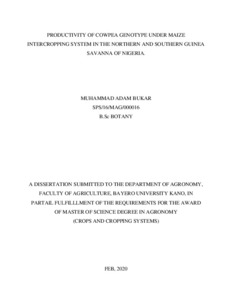
Productivity of cowpea genotype under maize intercropping system in the northern and southern Guinea Savanna of Nigeria
Date
2020-02Type
Review Status
Internal ReviewTarget Audience
Scientists
Metadata
Show full item recordAbstract/Description
A field experiment was conducted in 2018 rainy season at the International Institute of Agriculture Research Farms at Abuja and Zaria to know the adaptability of cowpea genotype to maize canopy in northern and southern Guinea savannah of Nigeria. The experiment consisted of 12 treatment combinations; of three cowpea varieties (SAMPEA 11, SAMPEA 14, and UAM09-126-19-2) in two cropping systems (sole and intercropped with EVDT99) and at two relay dates (5 and 8 WAS). The treatments were laid out in split split-plot design with cropping system, relay date and variety at the main plot, subplot, and sub-sub plot, respectively. The results of the experiment revealed that maize canopy significantly affected the yield and yield components of cowpea varieties with differences in varietal genetic inherence. Intercropped cowpea was observed to have decrease in the number of pods, number of seeds, 100 grain weight, total dry matter and grain yield. But the rate at which the canopy affects SAMPEA 11 was minimal; rating the significance difference in LAI, IPAR and grain yield with other varieties. System productivity and the economic benefits showed an intercropping advantage in all the indices used in determining the productivity of the research. LER and ATER indicated both cowpea and maize performed well upon their competitiveness in resource utilization. The aggressiveness of maize can always be acquainting with because of the resources it requires for optimum growth and productivity. This research entails that farmers should intercrop maize EVDT99 relayed with SAMPEA 11 at 5 and 8WAS in Zaria and Abuja, respectively to utilize resources most efficiently.
Permanent link to this item
https://hdl.handle.net/20.500.12478/8159IITA Authors ORCID
Alpha Kamarahttps://orcid.org/0000-0002-1844-2574