Welcome to the International Institute of Tropical Agriculture Research Repository
Exploiting the genetic potential of cowpea in an intercropping complex
View/
Date
2023Type
Review Status
Peer ReviewTarget Audience
Scientists
Metadata
Show full item recordAbstract/Description
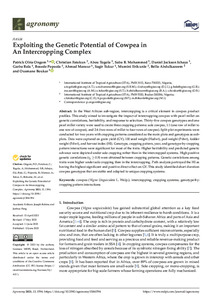
In the West African sub-region, intercropping is a critical element in cowpea product profiles. This study aimed to investigate the impact of intercropping cowpea with pearl millet on genetic correlations, heritability, and response to selection. Thirty-five cowpea genotypes and one pearl millet variety were used to create three cropping patterns: sole cowpea, 1:1 (one row of millet to one row of cowpea), and 2:4 (two rows of millet to four rows of cowpea). Split-plot experiments were conducted for two years with cropping patterns considered as the main plots and genotypes as sub-plots. Data were captured on grain yield (GY), 100 seed weight (Hsdwt), pod weight (Pdwt), fodder weight (Fdwt), and harvest index (HI). Genotype, cropping pattern, year, and genotype-by-cropping pattern interactions were significant for most of the traits. Higher heritability and predicted genetic advance were depicted under sole cropping rather than in the intercropped systems. High positive genetic correlations (rg ≥ 0.9) were obtained between cropping patterns. Genetic correlations among traits were higher under sole cropping than in the intercropping. Path analysis portrayed the HI as having the highest significant and positive direct effect on GY. This study identified short duration cowpea genotypes that are stable and adapted to unique cropping systems.
Multi standard citation
Permanent link to this item
https://hdl.handle.net/20.500.12478/8324IITA Authors ORCID
Patrick Ongomhttps://orcid.org/0000-0002-5303-3602
Christian Fatokunhttps://orcid.org/0000-0002-8428-7939
Abou TOGOLAhttps://orcid.org/0000-0001-6155-8292
Ousmane Boukarhttps://orcid.org/0000-0003-0234-4264
Digital Object Identifier (DOI)
https://doi.org/10.3390/agronomy13061594