Welcome to the International Institute of Tropical Agriculture Research Repository
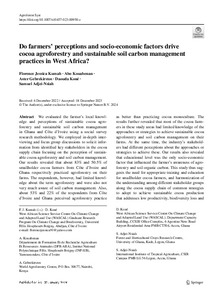
Do farmers' perceptions and socio-economic factors drive cocoa agroforestry and sustainable soil carbon management practices in West Africa?
View/
Date
2024-01-09Type
Review Status
Peer ReviewTarget Audience
Scientists
Metadata
Show full item recordAbstract/Description
We evaluated the farmer’s local knowledge and perceptions of sustainable cocoa agroforestry and sustainable soil carbon management in Ghana and Côte d'Ivoire using a social survey research methodology. We employed in-depth interviewing and focus group discussions to solicit information from identified key stakeholders in the cocoa supply chain focusing on the perception of sustainable cocoa agroforestry and soil carbon management. Our results revealed that about 83% and 50.5% of smallholder cocoa farmers from Côte d'Ivoire and Ghana respectively practiced agroforestry on their farms. The respondents, however, had limited knowledge about the term agroforestry and were also not very much aware of soil carbon management. Also, about 53% and 22% of the respondents from Côte d'Ivoire and Ghana perceived agroforestry practice as better than practicing cocoa monoculture. The results further revealed that most of the cocoa farmers in these study areas had limited knowledge of the approaches or strategies to achieve sustainable cocoa agroforestry and soil carbon management on their farms. At the same time, the industry’s stakeholders had different perceptions about the approaches or strategies to achieve these. Our results also revealed that educational level was the only socio-economic factor that influenced the farmer’s awareness of agroforestry and soil organic carbon. This study thus suggests the need for appropriate training and education for smallholder cocoa farmers, and harmonization of the understanding among different stakeholder groups along the cocoa supply chain of common strategies to adopt to achieve sustainable cocoa production that addresses low productivity, biodiversity loss and carbon emission within the smallholder cocoa production system in West Africa.
Multi standard citation
Permanent link to this item
https://hdl.handle.net/20.500.12478/8422IITA Authors ORCID
Samuel Adjei-Nsiahhttps://orcid.org/0000-0002-7394-4913
Digital Object Identifier (DOI)
https://doi.org/10.1007/s10457-023-00950-z