Welcome to the International Institute of Tropical Agriculture Research Repository
IITA Bibliography System: Recent submissions
Now showing items 1481-1500 of 8125
-
Visual soil examination and evaluation in the sub-humid and semi-arid regions of Kenya
(2021-07-10)Soil quality is indicated by the interaction of physical, chemical and biological soil properties. The importance of physical properties, for example soil structure, lies in the fact that they enhance chemical and biological soil functions. Consequently, periodic assessment of structural quality is an important aspect of soil quality management. Quantitative soil properties can be used as indirect indicator parameters for soil structural changes. However, measuring these properties is not applicable, ... -
How does cultivar, maturation, and pre-treatment affect nutritional, physicochemical, and pasting properties of plantain flours?
(2021-07-29)The effect of cultivar, ripening stage, and pre-treatment method were investigated on the nutritional, physicochemical, and pasting properties of plantain flours from two plantains and two plantain hybrids. There were significant variations (p < 0.05) in chemical composition and physical properties influenced by the interaction of cultivars, ripening stages, and pre-treatment methods. The highest levels of amylose, water-holding capacity (WHC), and oil-holding capacity (OHC) were observed in unripe ... -
Ethnobotanical characterization of scarlet eggplant (Solanum aethiopicum L.) varieties cultivated in Benin (West Africa)
(2021-09)The African eggplant (Solanum aethiopicum L.) is an important traditional vegetable cultivated in tropical regions for its edible fruits. In the Benin Republic, S. aethiopicum is mainly cultivated by rural farmers for food and for its use in traditional medicine. Assessing varietal diversity, endogenous knowledge, production constraints and farmers' preference criteria are of great importance for promotion and conservation purposes. Using rural appraisal tools and methods, an ethnobotanical study ... -
Unravelling drivers of high variability of on-farm cocoa yields across environmental gradients in Ghana
(2021-10)CONTEXT Cocoa (Theobroma cacao L.) is one of the world's most important agricultural commodity crops with the largest share of global production concentrated in West Africa. Current on-farm yields in this region are low and are expected to decrease in response to climate change, through warming and shifts in rainfall. Interventions intended to improve yields and climate adaptation require an understanding of the main drivers of yields across farms. OBJECTIVE In this regard, we quantified the extent ... -
The poverty impacts of improved soybean technologies in Malawi
(2021)Improved soybean varieties and agronomic practices have been widely disseminated to smallholder farmers in Malawi over the last 15 years. However, there is no empirical evidence on the welfare impacts of adopting improved soybean technologies. This paper estimated the poverty impacts of adopting improved soybean technologies using data from 1,234 households in six soybean growing districts accounting for over 80% of the total soybean production in the country. The results from an endogenous switching ... -
Farmers' perceptions on varietal diversity, trait preferences and diversity management of bush yam ( Dioscorea praehensilis Benth.) in Ghana
(2021)Bush yam (Dioscorea praehensilis Benth.) is an important food and cash crop species in some West and Central African countries. Unfortunately, several socioeconomic, cultural, nutritional, and agronomic constraints hinder its cultivation, and thus lead to its underutilization and gradual disappearance. To effectively promote its cultivation and utilization, knowledge of its diversity, distribution, management, and farmers’ varietal preferences is necessary. This study, therefore, used a participatory ... -
Agronomic gain: definition, approach, and application
(2021-08)Meeting future global staple crop demand requires continual productivity improvement. Many performance indicators have been proposed to track and measure the increase in productivity while minimizing environmental degradation. However, their use has lagged behind theory, and has not been uniform across crops in different geographies. The consequence is an uneven understanding of opportunities for sustainable intensification. Simple but robust key performance indicators (KPIs) are needed to standardize ... -
Genetic variability and population structure of Ethiopian Sesame (Sesamum indicum L.) germplasm assessed through phenotypic traits and simple sequence repeats markers
(2021)Ethiopia is one of the centers of genetic diversity of sesame (Sesamum indicum L.). The sesame genetic resources present in the country should be explored for local, regional, and international genetic improvement programs to design high-performing and market-preferred varieties. This study’s objective was to determine the extent of genetic variation among 100 diverse cultivated sesame germplasm collections of Ethiopia using phenotypic traits and simple sequence repeat (SSR) markers to select ... -
Push-pull strategy combined with net houses for controlling cowpea insect pests and enhancing crop yields
(2021-03)Net houses can be used in tropical environments to protect crops such as cowpea against large insect pests, thereby avoiding pesticide treatments while sustainably mitigating the effects of climate change. We investigated a push-pull strategy to prevent small insect pest outbreaks in a net house. The push component consisted of two stimulus plants, i.e. Cymbopogon citratus and Tagetes minuta, and the pull stimuli consisted of visual cues from blue and yellow sticky traps. Field experiments were ... -
Genetic diversity and structure of Musa balbisiana populations in Vietnam and its implications for the conservation of banana crop wild relatives
(2021)Crop wild relatives (CWR) are an indispensable source of alleles to improve desired traits in related crops. While knowledge on the genetic diversity of CWR can facilitate breeding and conservation strategies, it has poorly been assessed. Cultivated bananas are a major part of the diet and income of hundreds of millions of people and can be considered as one of the most important fruits worldwide. Here, we assessed the genetic diversity and structure of Musa balbisiana, an important CWR of plantains, ... -
Differences in seasons and rice varieties provide opportunities for improving nitrogen use efficiency and management in irrigated rice in Kenya
(2021-06-25)Apart from nitrogen (N) rates, N use efficiency (NUE) (yield N/total input N) is affected by seasons, crop developmental stages, and varieties. Knowledge of how these factors affect NUE in rice production in Kenya is limited. Therefore, field experiments were conducted with 'low rates' of N (simulating farmers' practices) of 0, 26, 52 and 78 kg N ha−1 with five varieties (MWUR1, MWUR4, IRAT109, NERICA4 and NERICA10) and higher rates of N (125, 175, and 225 kg N ha−1) simulating researchers' doses ... -
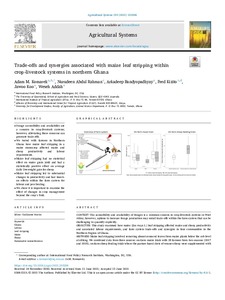
Trade-offs and synergies associated with maize leaf stripping within crop-livestock systems in northern Ghana
(2021)CONTEXT The accessibility and availability of forages is a common concern in crop-livestock systems in West Africa; however, options to increase forage production may entail trade-offs within the farm system that can be challenging to quantify explicitly. OBJECTIVE This study examined how maize (Zea mays L.) leaf stripping affected maize and sheep productivity and associated labour requirements, and farm system trade-offs and synergies in four communities in the Northern Region of Ghana. METHODS ... -
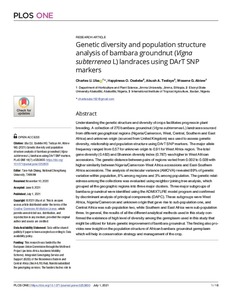
Genetic diversity and population structure analysis of bambara groundnut (Vigna subterrenea L) landraces using DArT SNP markers
(2021)Understanding the genetic structure and diversity of crops facilitates progress in plant breeding. A collection of 270 bambara groundnut (Vigna subterrenea L) landraces sourced from different geographical regions (Nigeria/Cameroon, West, Central, Southern and East Africa) and unknown origin (sourced from United Kingdom) was used to assess genetic diversity, relationship and population structure using DArT SNP markers. The major allele frequency ranged from 0.57 for unknown origin to 0.91 for West ... -
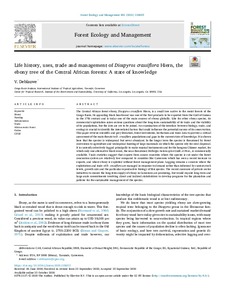
Life history, uses, trade and management of Diospyros crassiflora Hiern, the ebony tree of the central African forests: a state of knowledge
(2021)The Central African forest ebony, Diospyros crassiflora Hiern, is a small tree native to the moist forests of the Congo Basin. Its appealing black heartwood was one of the first products to be exported from the Gulf of Guinea in the 17th century and is today one of the main sources of ebony globally. Like for other ebony species, its commercial exploitation raises serious questions about the long-term sustainability of its trade and the viability of its populations, but the dots are yet to be ... -
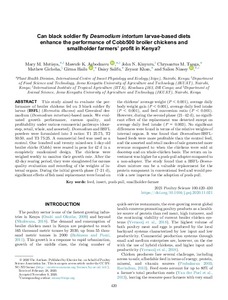
Can black soldier fly larvae-Desmodium intortum based diets enhance the performance of Cobb500(R) broiler chickens and smallholder farmers' profit in Kenya?
(2021-02)This study aimed to evaluate the performance of broiler chickens fed on 3 black soldier fly larvae (BSFL) (Hermetia illucens) and Greenleaf desmodium (Desmodium intortum)-based meals. We evaluated growth performance, carcass quality, and profitability under various commercial pathways (doorstep, retail, whole, and assorted). Desmodium and BSFL powders were formulated into 3 ratios: T1 25:75, T2 50:50, and T3 75:25. A commercial feed was used as a control. One hundred and twenty mixed-sex 1-day-old ... -
Sources of resistance to Pseudocercospora fijiensis, the cause of black Sigatoka in banana
(2021)Black Sigatoka, caused by Pseudocercospora fijiensis, is one of the most devastating diseases of banana. In commercial banana-growing systems, black Sigatoka is primarily managed by fungicides. This mode of disease management is not feasible for resource-limited smallholder farmers. Therefore, bananas resistant to P. fijiensis provide a practical solution for managing the disease, especially under smallholder farming systems. Most banana and plantain hybrids with resistance to P. fijiensis were ... -
Morphological characterization and genotypic identity of African yam bean (Sphenostylis stenocarpa Hochst ex. A. Rich. Harms) germplasm from diverse ecological zones
(2021)African yam bean (AYB) is an affordable protein source capable of diversifying the food base in sub-Saharan Africa. However, research efforts made towards the crop's improvement and in expanding production are limited. This study characterized 169 AYB accessions at Jimma, Ethiopia, using 31 phenotypic characters. The analysis of variance revealed highly significant (P < 0.01) differences for days to 50% flowering, days to first flowering, leaf area, number of seeds per pod, pod length, seed ... -
Changes in nutritional, texture, rancidity and microbiological properties of composite biscuits produced from breadfruit and wheat flours enriched with edible fish meal
(2021)The use of indigenous crops in the preparation of nutritious snacks such as biscuits has been reported as a means of alleviating the perennial problem of malnutrition among Nigerians, especially children. However, storage has been recognised as a factor affecting the attributes of these biscuits. This study investigated the quality changes of biscuit produced from fish meal enriched-composite flour of breadfruit and wheat. Freshly harvested seedless variety of breadfruit, matured catfish, wheat ... -
Genome-wide association studies for sex determination and cross-compatibility in water yam (Dioscorea alata L.)
(2021)Yam (Dioscorea spp.) species are predominantly dioecious, with male and female flowers borne on separate individuals. Cross-pollination is, therefore, essential for gene flow among and within yam species to achieve breeding objectives. Understanding genetic mechanisms underlying sex determination and cross-compatibility is crucial for planning a successful hybridization program. This study used the genome-wide association study (GWAS) approach for identifying genomic regions linked to sex and ...