Welcome to the International Institute of Tropical Agriculture Research Repository
IITA Bibliography System: Recent submissions
Now showing items 1601-1620 of 8126
-
Aflasafe SN01 is the first biocontrol product approved for aflatoxin mitigation in two nations, Senegal and The Gambia
(2020)Aflatoxin contamination is caused by Aspergillus flavus and closely related fungi. In The Gambia, aflatoxin contamination of groundnut and maize, two staple and economically important crops, is common. Groundnut and maize consumers are chronically exposed to aflatoxins, sometimes at alarming levels, and this has severe consequences on their health and productivity. Aflatoxin contamination also impedes commercialization in local and international premium markets. In neighboring Senegal, an aflatoxin ... -
Functional diversity of soil nematodes in relation to the impact of agriculture - a review
(2021-02-04)The analysis of the functional diversity of soil nematodes requires detailed knowledge on theoretical aspects of the biodiversity–ecosystem functioning relationship in natural and managed terrestrial ecosystems. Basic approaches applied are reviewed, focusing on the impact and value of soil nematode diversity in crop production and on the most consistent external drivers affecting their stability. The role of nematode trophic guilds in two intensively cultivated crops are examined in more detail, ... -
The functional and pasting properties of unripe plantain flour, and the sensory attributes of the cooked paste (amala) as affected by packaging materials and storage periods
(2020)Unripe plantain flour (UPF) is hygroscopic and gets spoilt if not correctly processed, packaged and stored. Thus, the need to study the functional and pasting properties of the UPF, and the sensory attributes of the cooked paste (amala) as affected by packaging materials and storage periods. The UPF was produced using the standard method, packaged in a polypropylene woven sack (PPS) and polyvinyl chloride container (PVC), stored for 20-weeks at room temperature and analyzed at 4-weeks intervals. ... -
Cyst nematode bio-communication with plants: implications for novel management approaches
(2020-09-28)Bio‐communication occurs when living organisms interact with each other, facilitated by the exchange of signals including visual, auditory, tactile and chemical. The most common form of bio‐communication between organisms is mediated by chemical signals, commonly referred to as ‘semiochemicals’, and it involves an emitter releasing the chemical signal that is detected by a receiver leading to a phenotypic response in the latter organism. The quality and quantity of the chemical signal released may ... -
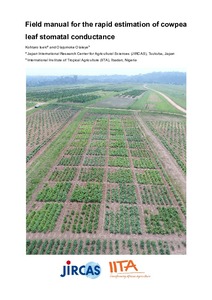
Field manual for the rapid estimation of cowpea leaf stomatal conductance
(2021-03-05)A thermal camera can be easily applied to measure leaf temperature-based indicators, such as stomatal conductance (gs), in large plant populations consisting of different varieties and under different treatments. However, a major difficulty in measuring these indicators is their fluctuation under different meteorological conditions. In this study, a new indicator of gs, GsI, was developed. The calculation of GsI includes the following factors: leaf and air temperatures, relative humidity, and solar ... -
Varietal selection in marginal agroecological niches and cultural landscapes: the case of rice in the Togo Hills
(2021-02-19)The Togo Hills borderland between Ghana and Togo is known for its cultural and ecological diversity and dynamic socio-political history. In this setting, African rice (Oryza glaberrima) is cultivated together with other local cultivars of Asian rice (O. sativa), and smallholders are keen innovators. This article presents the results of participatory variety selection (PVS) trials, in four different cultural and ecological settings within the Togo Hills, designed to understand farmers’ innovation ... -
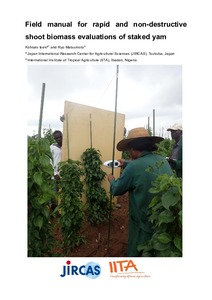
Field manual for rapid and non-destructive shoot biomass evaluations of staked yam
(2021-03-05)A rapid and easy method has been developed to evaluate the shoot biomass of staked yams. This method can reduce the time and cost required to evaluate shoot biomass when compared with destructive sampling methods. Using this new method, more than 200 accessions can be evaluated within 4 h, including the preparation time, while with the conventional methods of shoot sampling, oven drying, and weighing this process would take 3 days. In addition, owing to the non-destructive measurements of the ... -
Allometric equations, wood density and partitioning of aboveground biomass in the arboretum of Ruhande, Rwanda
(2021)There is growing interest in plantation forests throughout Africa because of their role in environment, economy and people's livelihoods. However, the contribution of planted forests to climate mitigation is poorly understood, partly due to lack of allometric equations for biomass estimation. This study aimed to determine wood density and biomass fractions in aboveground components, and to develop biomass estimation equations for multispecies plantation forests in the arboretum of Ruhande in Rwanda. ... -
Record of new host plants associated to the invasive mealybug species Paracoccus marginatus Williams and Granara de Willink (Hemiptera: Pseudococcidae) in the Center and Littoral regions of Cameroon
(2021)The papaya mealybug (PM) is a known notorious polyphagous insect pest of many plant species and has always been found associated with a new host/s in newly invaded areas. This pest recently invaded West and Central Africa. Surveys were conducted randomly from July 2014 to May 2018 to determine the host range of this pest in the Center and Littoral regions in Cameroon. Plants infested by PM were recognized by the presence of black sooty mould, leaf deformation and/or chlorosis. A standard infestation ... -
Application of CRISPR/Cas for diagnosis and management of viral diseases of banana
(2021)Viral diseases are significant biotic constraints for banana (Musa spp.) production as they affect the yield and limit the international movement of germplasm. Among all the viruses known to infect banana, the banana bunchy top virus and banana streak viruses are widespread and economically damaging. The use of virus-resistant bananas is the most cost-effective option to minimize the negative impacts of viral-diseases on banana production. CRISPR/Cas-based genome editing is emerging as the most ... -
Technological innovations for improving cassava production in sub-Saharan Africa
(2021-01)Cassava is crucial for food security of millions of people in sub-Saharan Africa. The crop has great potential to contribute to African development and is increasing its income-earning potential for small-scale farmers and related value chains on the continent. Therefore, it is critical to increase cassava production, as well as its quality attributes. Technological innovations offer great potential to drive this envisioned change. This paper highlights genomic tools and resources available in ... -
Opportunities and challenges for biofortification of cassava to address iron and zinc deficiency in Nigeria
(2021-03)Nigeria is the world's largest producer of cassava (Manihot esculenta), and its production is important to the country's economy. Cassava's edible storage roots act as a critical staple food for over 180 million Nigerians. Micronutrient deficiency presents a major public health issue in Nigeria and correlates with cassava consumption level across six-agro-ecological zones within the country. Though high in caloric value, cassava roots are deficient in minerals, placing populations that rely on ... -
Emergence of Maruca vitrata as a major pest of food legumes and evolution of management practices in Asia and Africa
(2021-01)Legume pod borer, Maruca vitrata, has emerged as a major pest on food legumes in Asia and Africa. It is an oligophagous pest, feeding on over 70 species in Fabaceae. We examine the species complex in Asia, Africa, Oceania, and the Americas, with an emphasis on molecular taxonomy. Studies on pheromone production and perception suggest the existence of pheromone polymorphism, especially in Asia and Africa. No Maruca-resistant varieties are available in the major food legumes including cowpea, ... -
Does agricultural cooperative membership impact technical efficiency of maize production in Nigeria: an analysis correcting for biases from observed and unobserved attributes
(2021)The formation of agricultural cooperatives has been widely promoted as an agricultural development policy initiative to help smallholder farmers cope with multiple production and marketing challenges. Using a nationally representative survey dataset of smallholder maize producers from rural Nigeria, this study assesses the impact of agricultural cooperative membership on technical efficiency (TE). We based our estimation approach on the combination of a newly developed sample selection stochastic ... -
Genetic analysis of extra-early yellow and orange quality protein maize (Zea mays L.) inbread lines under low nitrogen and Striga stresses
(University of Ghana, 2019-12)Low soil nitrogen (low-N) and Striga hermonthica (Del.) are major constrains hampering maize production in sub-Saharan Africa (SSA). Developing extra-early quality protein maize (QPM)-provitamin A hybrids that combine low-N tolerance with Striga resistance is crucial for addressing the food security and undernourishment challenges in SSA. The objectives of this study were to i) assess the genetic diversity among a group of extra-early yellow QPM and orange QPM-provitamin A maize inbred lines, ii) ... -
Digitalization of smallholder value chain lending partnerships: an interplay of trust and inclusion
(Wageningen University and Research Center, 2021) -
Contribution a la gestion agroecologique de Maruca vitrata Fab. et d'autres insectes ravageurs majeurs de la culture du niebe (Vigna unguiculata L. Walp.) dans les regions de Zinder et Maradi au Niger
(Universite Dan Dicko Dankoulodo De Maradi, 2020)Au Niger, le niébé (Vigna unguiculata L. Walp.) est une culture alimentaire importante mais son rendement est bas en raison de plusieurs contraintes biotiques et abiotiques. L’objectif de cette thèse est d’améliorer le rendement du niébé par la mise en place d’une stratégie écologique de lutte contre les principaux insectes ravageurs de la culture. Les activités suivantes ont été conduites : une enquête de base dans 19 villages des régions de Maradi et Zinder pour identifier les principales ... -
Innovation intermediation in a digital age: broadening extension service delivery in Ghana
(Wageningen University and Research Center, 2020)Classical extension focuses on linear transfer of technology. Globally, and in Ghana particularly, we have seen attempts to address the linearity of classical extension with the shift to broader extension service delivery approaches. From an innovation systems perspective innovation intermediation is suggested for extension organisations to function more effectively and respond to wider agricultural system constraints. This involves three broad facilitation roles which are demand articulation, ...