Welcome to the International Institute of Tropical Agriculture Research Repository
IITA Bibliography System: Recent submissions
Now showing items 1641-1660 of 8126
-
Intensification options of small holders’ cassava production in south‐west Nigeria
(2020)Cassava (Manihot esculenta Crantz) is a staple food crop in Nigeria, but root yields hardly exceed 10 t ha−1. Intensification of small holders’ cassava production is key to improved food security and income generation. We tested, in two demonstration trials and 20 on‐farm trials, different intensification options: cassava growth type (erect and branching), fertilizer application (with and without), and cassava − legume arrangement (0.5 by 2 m/1 by 1 m spacing of cassava) in demonstration trials. ... -
Perspectives on global mycotoxin issues and management from the mycokey maize working group
(2020)During the last decade, there have been many advances in research and technology that have greatly contributed to expanded capabilities and knowledge in detection and measurement, characterization, biosynthesis, and management of mycotoxins in maize. MycoKey, an EU‐funded Horizon 2020 project, was established to advance knowledge and technology transfer around the globe to address mycotoxins impacts in key food and feed chains. MycoKey included several working groups comprised of international ... -
Genomic analysis of selected maize landraces from Sahel and Coastal west Africa reveals their variability and potential for genetic enhancement
(2020)Genetic adaptation of maize to the increasingly unpredictable climatic conditions is an essential prerequisite for achievement of food security and sustainable development goals in sub-Saharan Africa. The landraces of maize; which have not served as sources of improved germplasm; are invaluable sources of novel genetic variability crucial for achieving this objective. The overall goal of this study was to assess the genetic diversity and population structure of a maize panel of 208 accessions; ... -
Grain legume seed systems for smallholder farmers: perspectives on successful innovations
(2020)Grain legumes are nutritionally important components of smallholder farming systems in sub-Saharan Africa and Asia. Unfortunately, limited access to quality seed of improved varieties at affordable prices due to inadequate seed systems has reduced their contribution to improving nutrition and reducing poverty in these regions. This paper analyses four seed systems case studies: chickpea in Ethiopia and Myanmar; cowpea in Nigeria; and tropical grain legumes in Nigeria, Tanzania and Uganda highlighting ... -
Influence of wounding and temperature on resistance of maize landraces from Mexico to aflatoxin contamination
(2020)Maize is a staple for billions across the globe. However, in tropical and sub-tropical regions, maize is frequently contaminated with aflatoxins by Aspergillus section Flavi fungi. There is an ongoing search for sources of aflatoxin resistance in maize to reduce continuous exposures of human populations to those dangerous mycotoxins. Large variability in susceptibility to aflatoxin contamination exists within maize germplasm. In Mexico, several maize landrace (MLR) accessions possess superior ... -
Improvement of smallholder farming systems in Africa
(2020-07-17)This forum paper provides a synthesis and discussion of 14 categories of lessons learned from experiences for achieving farm‐level impact with smallholder farmers in Africa. These lessons were reported in a symposium hosted by the Agronomy in Africa community of the American Society of Agronomy. The lessons, listed in order of frequency of reporting, were the need to: have adequate infrastructure and services; enable spontaneous adoption; have multi‐disciplinary and institutional collaboration; ... -
Scaling Readiness integration in an online innovation inventory tool: overview of objectives, design principles, workflows, results and ideas for future mainstreaming of Scaling Readiness in ProPAS
(International Institute of Tropical Agriculture, 2020) -
Perception of communities on managing exclosures as common pool resources in northwestern Ethiopia
(2021-01-15)Understanding the different perceptions of the local community regarding the use and management of common pool resources, such as exclosures, could better support targeted interventions by government and development partners. Here, we report on a study conducted in the Gomit watershed, northwestern Ethiopia, using a survey and key informant interviews, to examine community perceptions on (a) the biophysical condition (i.e., challenge of land degradation and restoration), (b) the action situations ... -
Shughuli zilizoboreshwa kwa ajili ya kupunguza upotevu na kuboresha mazao baada ya kuvuna: mwongozo wa mkufunzi kwa wakulima wadogo wa mahindi nchini Tanzania
(International Institute of Tropical Agriculture, 2020) -
Utayarishaji bora wa vyakula vya watoto wadogo: mwongozo kwa watoaji huduma ya lishe
(International Institute of Tropical Agriculture, 2020) -
Genome-wide association analysis for tuber dry matter and oxidative browning in water yam (Dioscorea alata L.)
(2020)Yam (Dioscorea spp.) is a nutritional and medicinal staple tuber crop grown in the tropics and sub-tropics. Among the food yam species, water yam (Dioscorea alata L.) is the most widely distributed and cultivated species worldwide. Tuber dry matter content (DMC) and oxidative browning (OxB) are important quality attributes that determine cultivar acceptability in water yam. This study used a single nucleotide polymorphism (SNP) assay from a diversity arrays technology (DArT) platform for a genome-wide ... -
Improvement of smallholder farming systems in Africa
(2020-07-17)This forum paper provides a synthesis and discussion of 14 categories of lessons learned from experiences for achieving farm‐level impact with smallholder farmers in Africa. These lessons were reported in a symposium hosted by the Agronomy in Africa community of the American Society of Agronomy. The lessons, listed in order of frequency of reporting, were the need to: have adequate infrastructure and services; enable spontaneous adoption; have multi‐disciplinary and institutional collaboration; ... -
Reducing risks of human exposure to antimicrobial resistance originating from livestock supply chains
(2021)Antimicrobial resistance is one of the biggest health threats for both humans and animals. This justifies the need for a conceptual framework that provides an integrated assessment of the measures and strategies that can be applied within livestock supply chains to reduce the risks of human exposure to resistant pathogens. The aim of this study is therefore to provide a comprehensive supply chain-based conceptualisation that describes the main measures and strategies to Rev. Sci. Tech. Off. Int. ... -
Evaluation of nutritional properties of cassava-legumes snacks for domestic consumption: consumer acceptance and willingness to pay in Zambia
(2020-08-25)High-quality cassava flour (HQCF) is a cheaper alternative to wheat in the production of snacks. This study assessed the nutritional properties and consumer acceptability of cassava-legume snacks in Zambia. Cassava snacks were made from 100% HQCF, 50:50 cassava-soybean flour blend, 50:50 cassava-cowpea flour blend and 100% wheat flour as the control. The samples were analyzed for nutritional, functional and anti-nutritional properties using standard laboratory methods. Also, a well-outlined ... -
Genome-wide association analyses reveal the genetic basis of biomass accumulation under symbiotic nitrogen fixation in African soybean
(2020)Symbiotic nitrogen fixation (SNF) increases sustainability by supplying biological nitrogen for crops to enhance yields without damaging the ecosystem. A better understanding of this complex biological process is critical for addressing the triple challenges of food security, environmental degradation, and climate change. Soybean plants, the most important legume worldwide, can form a mutualistic interaction with specialized soil bacteria, bradyrhizobia, to fix atmospheric nitrogen. Here we report ... -
Genome-wide association study of Striga resistance in early maturing white tropical maize inbred lines
(2020)Background: Striga hermonthica (Benth.) parasitism militates against increased maize production and productivity in savannas of sub-Saharan Africa (SSA). Identification of Striga resistance genes is important in developing genotypes with durable resistance. So far, there is only one report on the existence of QTL for Striga resistance on chromosome 6 of maize. The objective of this study was to identify genomic regions significantly associated with grain yield and other agronomic traits under ... -
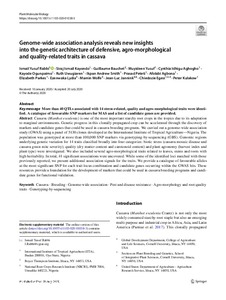
Genome-wide association analysis reveals new insights into the genetic architecture of defensive, agro-morphological and quality-related traits in cassava
(2020)Cassava (Manihot esculenta) is one of the most important starchy root crops in the tropics due to its adaptation to marginal environments. Genetic progress in this clonally propagated crop can be accelerated through the discovery of markers and candidate genes that could be used in cassava breeding programs. We carried out a genome-wide association study (GWAS) using a panel of 5,310 clones developed at the International Institute of Tropical Agriculture - Nigeria. The population was genotyped at ... -
Genetic analysis of tuber yield and quality traits in white yam (Dioscorea rotundata Poir)
(University of Ghana, 2019-12)The genetic progress in tuber yield and quality attributes of yam is constrained by prolonged breeding cycle, complex ploidy (2n=40, 60, 80), high heterozygousity, complex flowering pattern (dioecois and monoecious flowering and shy to flower), multi-species, low propagation ratio, biotic and abiotic factors. Genetic improvement of yam with high tuber yield, high dry matter content, starch and other food quality attributes using traditional and modern breeding techniques will contribute to the ... -
Genetic diversity and population structure of maize inbred lines with varying levels of resistance to striga hermonthica using agronomic trait-based and SNP markers
(2020)Striga hermonthica is a serious biotic stress limiting maize production in sub-Saharan Africa. The limited information on the patterns of genetic diversity among maize inbred lines derived from source germplasm with mixed genetic backgrounds limits the development of inbred lines, hybrids, and synthetics with durable resistance to S. hermonthica. This study was conducted to assess the level of genetic diversity in a panel of 150 diverse maize inbred lines using agronomic and molecular data and ...