Welcome to the International Institute of Tropical Agriculture Research Repository
IITA Bibliography System: Recent submissions
Now showing items 1721-1740 of 8126
-
Bioactivity of essential oils of Cymbopogon citratus (DC) Stapf and Cymbopogon nardus (L.) W. Watson from Benin against Dinoderus porcellus Lesne (Coleoptera: Bostrichidae) infesting yam chips
(2020-08-18)Dinoderus porcellus L. (Coleoptera: Bostrichidae) is a most abundant and damageable pest of stored yam chips in West Africa. In view of the negative effects related to the use of synthetic chemical insecticide, it is important to develop alternative eco-friendly methods of control, such as the use of plant essential oils. The chemical composition and biological effects (repellent, antifeedant, contact and fumigant toxicity) of essential oils from Cymbopogon citratus (DC) Stapf and Cymbopogon nardus ... -
Modeling planting-date effects on intermediate-maturing maize in contrasting environments in the Nigerian savanna: an application of DSSAT model
(2020-06)The Crop Environment Resource Synthesis (CERES)-Maize model in Decision Support System for Agricultural Technology Transfer (DSSAT) was calibrated and evaluated with experimental data for simulation of response of two intermediate-maturing maize varieties to different sowing dates in the Nigerian savannas. The calibration experiments involved 14 consecutive field trials conducted in the rainy and dry seasons in Bayero University Kano (BUK), Dambatta, and Zaria between 2014–2019. Two sets of field ... -
Canopy cover evolution, diurnal patterns and leaf area index relationships in a Mchare and Cavendish banana cultivar under different soil moisture regimes
(2020-10)The biggest abiotic threat to banana (Musa spp.) production is water deficit, but physiological indicators in plantations are lacking. Canopy Cover (CC) seems to be a relevant parameter, but so far not used in banana fields. Field experiments were conducted to determine the effect of optimal irrigation (FI) versus rainfed (RF) on CC and Leaf Area Indices (LAI) in two experiments with different cultivars (Mchare ‘Huti Green’ [HG, AA] and Cavendish ‘Grand Naine’[GN, AAA]) (n = 3 for HG, n = 4 for ... -
Melanization of eggs and larvae of the parasitoid, Epidinocarsis lopezi (Hymenoptera: Encyrtidae), by the cassava mealybug, Phenacoccus manihoti (Homoptera:Pseudococcidae)
(1988)The encyrtid wasp Epidinocarsis lopezi (De Santis) has been introduced into Africa as a biological control agent against the cassava mealybug Phenacoccus manihoti Matile-Ferrero. This host has a defense reaction against the immature parasitoid that involves encapsulation and melanization. Under laboratory conditions, 37.5% of once-stung cassava mealybugs had been parasitized, as indicated by eggs and larvae of the parasitoid in dissected hosts. Of these parasitized cassava mealybugs, 89.6% contained ... -
Changes in the composition of the fauna associated with the cassava mealybug, Phenacoccus manihoti, following the introduction of the parasitoid Epidinocarsis lopezi
(1987-12)Over 130 species of insects were found in association with the cassava mealybug (CM), Phenacoccus manihoti, and its newly introduced parasitoid Epidinocarsis lopezi in Africa. As the CM in SW Nigeria declined under the influence of E. lopezi, this introduced wasp maintained densities of 2.8-3 per CM-infested tip early in the dry season and 1.3-1.6 per infested tip late in the dry season, but declined overall from 1.3 to 0.2 per randomly collected tip within 1 year. The decline of CM led to a sharp ... -
Introduction and dispersal of Epidinocarsis lopezi (Hym., Encyrtidae), an exotic parasitoid of the cassava mealybug, Phenacoccus manihoti (Hom., Pseudococcidae), in Africa
(1987-06)In 1981 the South American parasitoid Epidinocarsis lopezi (DeSantis) was imported into Nigeria for control of the cassava mealybug, Phenacoccus manihoti Mat.-Ferr. It was multiplied in an insectary at the International Institute of Tropical Agriculture (IITA), Ibadan, and first released in 1981/82. Within 3 years it dispersed over 200 000 km2 in southwestern Nigeria, occupying between 70 and 98% of all fields. By December 1985, a total of over 50 releases in 34 regions had been made in 12 African ... -
Impact of the exotic parasitoid Epidinocarsis lopezi on cassava mealybug (Phenacoccus manihoti) populations
(1987-12)Epidinocarsis lopezi an exotic parasitoid to Africa, was first released to control the cassava mealybug (CM), Phenacoccus manihoti, at IITA (Ibadan) in November 1981, and a year later at Abeokuta, both in southwestern Nigeria. Population dynamics study of CM and its natural enemies was conducted for 4 years. CM population peaks usually occurred during the second half of the dry season (January-April). E. lopezi was the only natural enemy that was found during the whole year and in high densities. ... -
An overview of a systems model of cassava and cassava pests in Africa
(1987)A systems model is described for cassava, Manihot esculenta Crantz, two of its introduced herbivores, the cassava green mite (CGM), Mononychellus tanajoa (Bondar), sensu lato, and the cassava mealybug (CM), Phenacoccus manihoti Mat.-Ferr., the introduced CM parasitoid, Epidinocarsis lopezi (DeSantis) and coccinellid predator of the genus Hyperaspis. The systems model includes the effects of weather, soil nitrogen and water levels on the interactions of the system’s components. The model simulates ... -
Survey and management of potato pests in Uganda
(International Institute of Tropical Agriculture, 2019-12)Potato (Solanum tuberosum L.) is an important food and income generating crop for its growers. The crop is also nutritionally rich in carbohydrates, vitamins (C and B), proteins, minerals (potassium) among other nutritional components. In Uganda, potato has been recognized as a crop with potential for nutrition security and income generation. Despite these benefits, average potato yield (4.8 t/ha) in Uganda is still comparatively lower than attainable global average yield (30 to 40 t/ha), owing ... -
Using a participatory approach and legume integration to increase the productivity of early maturing maize in the Nigerian Sudan Savannas
(2019)Drought, infestation of cereal crops by the parasitic weed Striga hermonthica, and poor soil fertility are the major constraints to maize production by smallholder farmers in the Sudan savannas of northern Nigeria. Four innovation platforms (IPs) were therefore established in 2008 in the Sudan savanna (SS) agroecological zone of northern Nigeria to create a stakeholder forum to address these identified food production challenges in the target areas. The IPs comprised researchers from Bayero ... -
Review of empirical and emerging breeding methods and tools for yam (Dioscorea spp.) improvement: status and prospects
(2020-06)Yam (Dioscorea spp.) is an important tuber crop with tremendous potential as a functional food in the tropics and subtropics. However, the crop has not shown progressive productivity gain over decades due to various production constraints. This paper reviews the progress achieved in empirical breeding endeavours and the development, status and application of emerging breeding tools and technologies to translate genetic gains in yam improvement. Significant progress has been made in yam genetic ... -
Protein-rich legume and pseudo-cereal crop suitability under present and future European climates
(2020)Replacing animal proteins with plant proteins in diets has been demonstrated to have both health and environmental advantages, driving a debate about the potential of protein-rich crops as dietary replacements for animal products. However, there is a lack of knowledge on how climate change could influence the potential for producing protein-rich crops. This study addresses this knowledge gap for the European Union. We analysed 13 protein-rich crops, using the crop suitability model EcoCrop and ... -
Effect of Beauveria bassiana and Metarhizium anisopliae on the adult African rice gall midge (AfRGM – Orseolia oryzivora)
(2019)Rice is an important staple crop whose production is limited by array of insect pests and diseases. African rice gall midge (AfRGM) Orseolia oryzivora Harris & Gagné (Diptera: Cecidomyiidae) is a major insect pest of lowland rice ecology in Africa. Heavy yield losses have been recorded in many farmers’ rice fields. Use of synthetic insecticides has fostered environmental and human health concern that initiates a search for alternative control measures such as Entomopathogenic fungi (EPF) – Beauveria ... -
Phenotypic and molecular assessment of genetic structure and diversity in a panel of winged yam (Dioscorea alata) clones and cultivars
(2019)A better understanding of the structure and extent of genetic variability in a breeding population of a crop is essential for translating genetic diversity to genetic gain. We assessed the nature and pattern of genetic variability and differentiation in a panel of 100 winged-yam (Dioscorea alata) accessions using 24 phenotypic traits and 6,918 single nucleotide polymorphism (SNP) markers. Multivariate analysis for phenotypic variability indicated that all phenotypic traits assessed were useful in ... -
Nutritional characteristics of selected insects in Uganda for use as alternative protein sources in food and feed
(2019)Insects are potential ingredients for animal feed and human food. Their suitability may be influenced by species and nutritional value. This study was aimed at determining the nutritional profile of four insects: Dipterans; black soldier fly (Hermetia illucens Linnaeus) family stratiomyidae and blue calliphora flies (Calliphora vomitoria Linnaeus) family Calliphoridae; and orthopterans; crickets (Acheta domesticus Linnaeus) family Gryllidae and grasshoppers (Ruspolia nitidula Linnaeus) family ... -
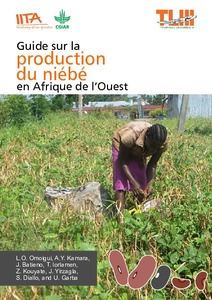
Guide sur la production du niebe en Afrique de l'Ouest
(International Institute of Tropical Agriculture, 2018) -
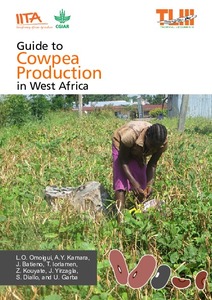
Guide to cowpea production in west Africa
(International Institute of Tropical Agriculture, 2018) -
The influence of minisett size and time of planting on the yield of seed yam (Dioscorea Rotundata)
(2020-05-22)In traditional yam (Dioscorea spp.) production systems in West Africa, finding sole seed yam producers is rare and up to 30% of harvested tubers from the ware tuber crop is reserved to plant an equivalent area of the harvested crop during the next season. Many farmers typically must make a trade-off between food and seed in the use of available tubers. A study was carried out using a factorial experiment in a randomised complete block design to investigate the influence of planting different ...