Welcome to the International Institute of Tropical Agriculture Research Repository
IITA Bibliography System: Recent submissions
Now showing items 1701-1720 of 8126
-
Common bean value chain actors share their feeling about TL projects in Tanzania
(Springer International Publishing, 2020)Apart from groundnut, Tropical Legumes I, II, and III also focused on common beans in Tanzania. In early April 2018, we visited Selian Agricultural Research Institute in Arusha, which is in the Northeast of Tanzania, and about 100 km from the Kenyan border. We also visited Mbeya, a town in the Southwest of Tanzania, just about 100 km from both Malawi and Zambia borders. Here, we found the first collaborator of Michael Kilango at Tanzania Agricultural Research Institute-Uyole who took us to meet ... -
Scientific animations without borders: cell-phone videos for cowpea farmers
(International Institute of Tropical Agriculture, 2012)Over the past several decades, researchers and extension agents have described methods that cowpea farmers can use to reduce insect damage to the cowpea crop in the field and in storage. Some of these methods, which are based on both scientific research and indigenous knowledge, are currently being used in local, regional , national, and transnational extension programs. Cowpea farmers in Africa and other developing regions, however, often remain unaware of the methods based on scientific research ... -
Concluding remarks: the tropical legumes projects empowered communities in a wide variety of assets
(Springer International Publishing, 2020)After 12 years of activity, the Tropical Legumes (TL) projects come to an end the year 2019. In addition to quantitative impact assessment, this publication brings to light various stakeholders’ own words about the kind of benefits they have made thanks to the TL projects. Research institutions, management and technical staff, extension services, NGOs, public and private seed companies, agro-dealers, farmer cooperatives, farmer groups, individual seed entrepreneurs, farmers, women farmers, processors, ... -
Breeding climate-resilient bananas
(Springer International Publishing, 2020-02-28)The impact of global climate change is expected to have the most significant effects on small-scale farmers in subtropical and tropical regions of the world without access to irrigation where banana is grown as an important staple crop. As a consequence, banana breeding needs to re-evaluate priorities and dedicate resources toward producing drought-tolerant cultivars. Specific challenges to breeding bananas for drought stress include the plants’ perennial nature, non-seasonal flowering, physical ... -
Productivity, water use and climate resilience of alternative cocoa cultivation systems
(Georg-August-University of Gottingen, 2017-12)Global demand for cocoa beans is projected to keep rising while future production is likely to be limited by climate variability and change. Over 70% of the global cocoa supply comes from West Africa, a region expected to be greatly affected by climate change and extreme droughts. Cocoa production in West Africa needs to be adapted to more marginal and extreme climatic conditions, mainly drought, to sustain production and avoid further deforestation of the remaining rainforest for its cultivation. ... -
Efficacy of cassava-maize intercrop on weed control and yield of component crops
(University of Ilorin, 2019)Low yield of maize/cassava intercrop is majorly due to some identified constraints like poor density of component crops, inappropriate application of fertilizer and weed infestation. This study was conducted in Otukpo-Icho, southern Guinea savanna of Nigeria and Igbariam, Humid Tropical Forest of Nigeria during 2018/2019 cropping season to determine the weed control efficiency and performance of cassava/maize intercrop. The trials were laid out as randomized complete block design in a factorial ... -
Sowing legume seeds, reaping cash: a renaissance within communities in sub-Saharan Africa
(Springer International Publishing, 2020)The smallholder farmers’ access to the outputs of the breeding programs’ achievements has been very weak and hence calls for effective, more coherent, and wellarticulated design of technology and seed delivery systems of food legume crops. The Tropical Legumes projects responded to this need. This book shares impact stories and testimonies from various value chain actors who were part of the Tropical Legumes (TL) projects over the past 12 years. It presents the experiences of a diversity of actors ... -
Africa research in sustainable intensification for the next generation: sustainable intensification of key farming systems in east and southern Africa
(International Institute of Tropical Agriculture, 2019-11) -
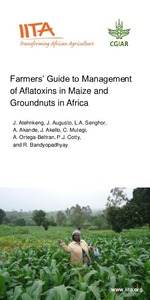
Farmers’ guide to management of aflatoxins in maize and groundnuts in Africa
(International Institute of Tropical Agriculture, 2017) -
Guide to maize production in northern Nigeria
(International Institute of Tropical Agriculture, 2020) -
Genetic analysis of resistance to Radopholus similis in Banana
(Makerere University, 2019-12)Banana is an important crop worldwide mostly grown in tropical and subtropical regions, of annual production is 145 million metric tons valued at 26.5 billion Euros. Banana production is threatened by various constraints including pests and diseases. Among the pests, Radopholus similis is the most destructive species. East African Highland Bananas mostly grown in Uganda and other parts of East Africa are highly susceptible to this species with yield reduction reaching 80%. Breeding for resistance ... -
Africa RISING east and southern Africa project overview
(Africa RISING, 2019) -
Effect-directed profiling and identification of bioactive metabolites from field, in vitro -grown and acclimatized Musa spp. accessions using high-performance thin-layer chromatography-mass spectrometry
(2020-04-12)Bananas and plantains ( Musa spp.) are used as nutritious foods, and at the same time, are a source of phytoconstituents for the pharmaceutical industry. As biological activities of especially the pulp and peel of Musa spp. have been documented, this study investigated the variation in the secondary metabo- lite profiles of the leaves from field, in vitro -grown and acclimatized accessions. The genetic fidelity of the diverse accessions was assessed using diversity array technology sequencing. It ... -
Cassava mosaic viruses (Geminiviridae)
(Elsevier, 2020) -
Plant resistance to Geminiviruses
(Elsevier, 2020) -
Productivity, water- and nitrogen-use efficiency, and profitability of pearl millet (Pennisetum glaucum) under different nitrogen applications in semiarid region of Nigeria
(2020-08-27)An experiment was conducted to examine the performance of pearl millet under different nitrogen (N) fertilizer rates in two locations in the semiarid zone of Nigeria. The objective was to evaluate the effects of different N rates on pearl millet yields, water- and nitrogen-use efficiency, and profitability. Grain yield increased by 23, 26, 32, 32, and 27% and by 38, 41, 54, 58, and 56% compared to unfertilized plots when applying 20, 40, 60, 80, and 100 kg Nha−1 in Minjibir and Gambawa, respectively. ... -
The effect of traditional and improved solar drying methods on the sensory quality and nutritional composition of fruits: a case of mangoes and pineapples
(2020-06)Background This study investigated the effect of traditional and improved solar drying methods on the sensory quality and nutritional composition of the dried fruit products; using mangoes and pineapples, as a case study. The fruits were dried under five solar drying methods namely; open sun drying (OSD), black-cloth shade (BCS), white-cloth shade (WCS), a conventional solar dryer (CSD), and a newly improved solar dryer (ISD) technology. The ISD unit was made of a modified solar concentrator ... -
Evolutionary distance explains shade tree selection in agroforestry systems
(2020-12)Enhancing agrobiodiversity offers a suite of functions key to the sustainability of low input agroecosystems. The pairing of shade trees in pan-tropical tree-crop systems represents one of the most common and widespread applications of agroecosystem diversification, yet given the vastly heterogeneous conditions in which shade tree selection is made, generalizable advances in the identification of suitably paired tree-crop and shade tree is essential for performance and adoption. Here, we determine ... -
Science of scaling: understanding and guiding the scaling of innovation for societal outcomes
(2020-09)This Editorial to the Special Issue “Science of Scaling: connecting the pathways of agricultural research and development for improved food, income and nutrition security” presents the framing, overview and analysis of 10 articles focussed on scaling innovation in the agricultural research for development sector. The publications cut across three categories that focus on: (i) Understanding the scaling trajectory retrospectively from a longer term, systems perspective, (ii) Understanding scaling ...