Welcome to the International Institute of Tropical Agriculture Research Repository
IITA Bibliography System: Recent submissions
Now showing items 1681-1700 of 8126
-
In-situ chlorophyll fluorescence and related growth of white Guinea yam at different ages
(2004)Leaf chlorophyll photochemical attributes and growth of two cultivars of white Guinea yam (Dioscorea rotundata) were examined. The photochemical efficiency (Fv/Fm ratio) of cv. Pepa was significantly higher than that of cv. Abi at 10, 14 and 22 weeks after transplanting (WAT). The peak photosynthetic efficiency period for both cultivars was at 18 WAT. Leaf area indices and crop growth rate were greater for Pepa than Abi, as was the leaf transpiration rate. During peak growth periods Pepa was less ... -
Sheep fattening and fodder-soil conservation in Ethiopia: an outcome case study report
(Technologies for African Agricultural Transformation, 2020) -
Deployment of maize technologies in western Kenya: an outcome case study report
(Technologies for African Agricultural Transformation, 2020) -
End-user preferences for plantain food products in Nigeria and implications for genetic improvement
(2020)Plantain is an important food security crop for farming households in Nigeria. This study investigates the relative importance of plantain food products and their quality descriptors from the perspective of farmers in Southern‐Nigeria, to inform end‐user oriented and socially inclusive breeding strategies that drive hybrid adoption. Surveys were conducted in twelve rural communities in three states in the plantain belt of Nigeria, consisting of key informant interviews, sex‐disaggregated focused ... -
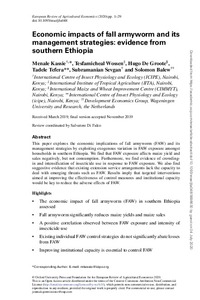
Economic impacts of fall armyworm and its management strategies: evidence from southern Ethiopia
(2020-09)This paper explores the economic implications of fall armyworm (FAW) and its management strategies by exploiting exogenous variation in FAW exposure amongst households in southern Ethiopia. We find that FAW exposure affects maize yield and sales negatively, but not consumption. Furthermore, we find evidence of crowding-in and intensification of insecticide use in response to FAW exposure. We also find suggestive evidence that existing extension service arrangements lack the capacity to deal with ... -
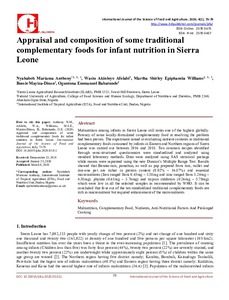
Appraisal and composition of some traditional complementary foods for infant nutrition in Sierra Leone
(2020)Malnutrition among infants in Sierra Leone still ranks one of the highest globally. Potency of some locally-formulated complementary food at resolving the problem had been proven. The experiment aimed at evaluating nutrient contents in traditional complementary foods consumed by infants in Eastern and Northern regions of Sierra Leone was carried out between 2016 and 2018. Ten common recipes identified through semi-structured questionnaire were standardized and analyzed using standard laboratory ... -
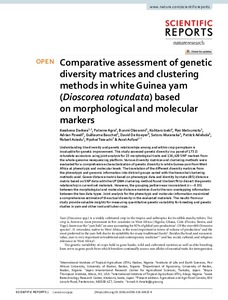
Comparative assessment of genetic diversity matrices and clustering methods in white Guinea yam (Dioscorea rotundata) based on morphological and molecular markers
(2020)Understanding the diversity and genetic relationships among and within crop germplasm is invaluable for genetic improvement. This study assessed genetic diversity in a panel of 173 D. rotundata accessions using joint analysis for 23 morphological traits and 136,429 SNP markers from the whole-genome resequencing platform. Various diversity matrices and clustering methods were evaluated for a comprehensive characterization of genetic diversity in white Guinea yam from West Africa at phenotypic and ... -
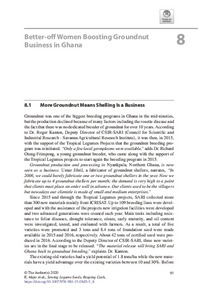
Better-off women boosting groundnut business in Ghana
(Springer International Publishing, 2020)Groundnut was one of the biggest breeding programs in Ghana in the mid-nineties, but the production declined because of many factors including the rosette disease and the fact that there was no dedicated breeder of groundnut for over 10 years. According to Dr. Roger Kanton, Deputy Director of CSIR-SARI (Council for Scientific and Industrial Research - Savanna Agricultural Research Institute), it was then, in 2015, with the support of the Tropical Legumes Projects that the groundnut breeding program ... -
Combining ability of extra-early maize inbreds derived from a cross between maize and Zea diploperennis and hybrid performance under contrasting environments
(2020)Knowledge of the genetic mechanisms conditioning drought tolerance in maize is crucial to the success of hybrid breeding programs aimed at developing high-yielding cultivars under drought. The objectives of this study were to determine the combining ability of extra-early inbreds, compute the heritability of measured traits, assess the performance of inbreds in hybrid combinations and investigate the associations among traits under drought and optimal conditions. A total of 252 hybrids generated ... -
Physicochemical properties and total carotenoid content of high-quality unripe plantain flour from varieties of hybrid plantain cultivars
(2020)Unripe plantain has been considered as having commercial potential or used as an ingredient for other foods. Information on the physicochemical and carotenoid properties of flours from hybrid plantain cultivars in the literature is limited. This study was conducted to determine the physicochemical properties and carotenoid contents of unripe plantain flour from selected hybrid plantain cultivars using standard laboratory methods. The unripe plantain pulps of four varieties (PITA 26, PITA 27, Mbi ... -
Assessment of the current agricultural finance sector with a major focus on cocoa: bank of Ghana (BOG) policy and strategies for financing sustainable agricultural value chains
(International Institute of Tropical Agriculture, 2019) -
Policy document and brief for engagement with government and private sector in cocoa: a case of Ghana
(International Institute of Tropical Agriculture, 2019) -
Enthusiasm of actors within the groundnut value chain sharing impact stories in Uganda
(Springer International Publishing, 2020)The role of women in traditional African homes is often considered subordinate than that of men. Women in most cases are expected to look after the household and the children and ensure food security while men, on the other hand, are tasked with ensuring financial security. In Uganda, women contribute to 53% agricultural labor force; this is because they have limited access to land and thus resort to offering labor to farm owners. Tropical Legumes projects has strived to empower women through ... -
Empowered communities tell their own stories from common bean production in Uganda
(Springer International Publishing, 2020)Most smallholder farmers in Uganda often opt to farm the more popular crops which include coffee, plantain, cassava, sweet potatoes, and maize. Smallholder bean farming in Uganda is however overtaking the crops as farmers are seeing the potential that bean farming possesses. Women in the traditional Ugandan setting are considered as care givers and are tasked with ensuring food security. In Northern Uganda for instance, women are not entitled to inheriting land. When it comes to land sharing, women ... -
Interseeding timing of cowpea (Vigna unguiculata L. Walp.) living mulch on weed diversity, physical soil properties and performance of maize (Zea mays L.)
(University of Development Studies, 2019)This trial was conducted to determine cowpea living mulch and maize maturity type effect on soil physical properties, maize yield and weed management. The study was a 3 x 4 factorial experiment laid out in Randomised Complete Block Design with 3 replications. Three maize maturity types: extra early Abontem, early Omankwa and medium Obatanpa and four living mulch systems: cowpea living mulch interseeded same day with maize (SDWM), cowpea living mulch interseeded 1 Week after planting maize (WAPM), ... -
Gender and access to cowpea innovations in West Africa: a review of some critical issues
(International Institute of Tropical Agriculture, 2012)Cowpea provides food and incomes to farm households including women farmers who make and sell snack foods from this nutritious legume in West Africa. Gender roles are important in cowpea value chains. The main constraints reported by women are poor access to cowpea innovations, opportunities, and related capacity building. The overall objective of this paper is to review key constraints and opportunities for an effective inclusion of women in cowpea value chains through access to innovations using ... -
Evaluation of starches from selected yellow and white flesh cassava roots for noodles production
(Federal University of Agriculture, Abeokuta, 2020)Cassava starch has been prospected in many food products manufacture. However, its suitability for making starch noodle has not been reported. Hence, this study was conducted to determine cassava starch‘s suitability in starch noodles production. The study was based on a completely randomized design with cassava variety as the main source of variation. The physicochemical properties [paste clarity (PCL), gel strength (GS), retrogradation], amylose content (AC), thermal properties [onset temperature, ... -
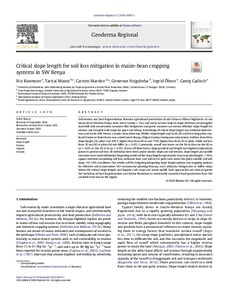
Critical slope length for soil loss mitigation in maize-bean cropping systems in SW Kenya
(2020)Soil erosion and land fragmentation threaten agricultural production of sub-Saharan African highlands. At our study site in Western Kenya, farm size is mostly < 2 ha, laid out in narrow strips in slope direction and ploughed downhill. Soil conservation measures like hedgerows and green manures can reduce effective slope length for erosion, but compete with crops for space and labour. Knowledge of critical slope length can minimise interventions and trade–offs. Hence, a maize–bean intercrop (MzBn) ... -
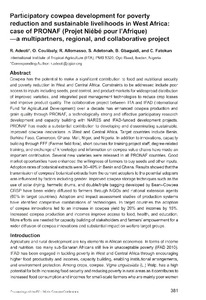
Participatory cowpea development for poverty reduction and sustainable livelihoods in west Africa: case of PRONAF (Projet Niebe pour l'Afrique)- a multipartners, regional, and collaborative project
(International Institute of Tropical Agriculture, 2012)Cowpea has the potential to make a significant contribution to food and nutritional security and poverty reduction in West and Central Africa. Constraints to be addressed include poor access to inputs including seeds, pest control, and product markets for widespread distribution of improved varieties, and integrated pest management technologies to reduce crop losses and improve product quality. The collaborative project between IITA and IFAD (International Fund for Agricultural Development) over ... -
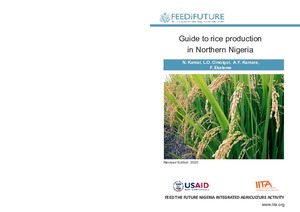
Guide to rice production in northern Nigeria
(International Institute of Tropical Agriculture, 2020-03)