Welcome to the International Institute of Tropical Agriculture Research Repository
IITA Bibliography System: Recent submissions
Now showing items 1761-1780 of 8126
-
Cowpea (Vigna unguiculata (L.) Walp) for food security: an evaluation of end-user traits of improved varieties in Swaziland
(2019)Improved varieties have agronomic advantages over local varieties,but not much attention has been given to understand the nutritional content of the improved cowpea varieties released in Swaziland. This study investigated the physical and nutritional properties of improved cowpea varieties released in Swaziland. Five improved varieties (IT-04K-321-2, IT-97K-390-2, IT-18, IT-16, and IT-99K-494-6) and one local variety (Mtilane, as check) were analyzed for physical and chemical properties. The results ... -
Studies on estimation of heterosis for striga resistance in maize test crosses in Mali
(2019)Heterosis for yield, secondary traits and Striga resistance was estimated in maize test crosses generated from fifteen inbred lines and three testers using line by tester analysis. Hybrids, testcrosses and parents were evaluated for two years at Agricultural Research Institute, Sotuba and Sanankoroba, to identify combinations expressing high hybrid vigor in Mali under Striga- infested and Striga-free conditions. Under Striga-free condition TZISTR106/TZISTR1230, TZISTR106/TZISTR1223 and TZISTR1033/ ... -
Reducing child undernutrition through dietary diversification, reduced aflatoxin exposure, and improved hygiene practices: the immediate impacts in central Tanzania
(2019)The study aimed to quantify the immediate effects of dietary diversification, food safety, and hygiene interventions on child undernutrition in four rural villages in Kongwa district of central Tanzania. One hundred mothers with their children of less than 24 months old were recruited for this study. The difference-in-difference (DID) method was used to assess the effects of intensive intervention through a learning-by-doing process on the topic of aflatoxin free diversified food utilization and ... -
Welfare impacts of climate-smart agriculture in Ghana: does row planting and drought-tolerant maize varieties matter?
(2020-06)This study provides new evidence of the impact of climate-smart agriculture (CSA) – row planting and drought-tolerant maize varieties - on farm and welfare outcomes by estimating a multinomial endogenous switching regression model that corrects for selection bias and farmer heterogeneity in CSA choice. Application of our model to panel observations of 438 households in Ghana show that adoption of CSA increases both yield and intensity of maize commercialization but negatively affect own consumption. ... -
Cowpea (Vigna unguiculata (L.) Walp) for food security: an evaluation of end-user traits of improved varieties in Swaziland
(2019)Improved varieties have agronomic advantages over local varieties,but not much attention has been given to understand the nutritional content of the improved cowpea varieties released in Swaziland. This study investigated the physical and nutritional properties of improved cowpea varieties released in Swaziland. Five improved varieties (IT-04K-321-2, IT-97K-390-2, IT-18, IT-16, and IT-99K-494-6) and one local variety (Mtilane, as check) were analyzed for physical and chemical properties. The results ... -
Participation or legitimisation? Assessment of quality of participation in farmer learning video production in central Uganda
(2019)Purpose: This study assessed the quality of participation in farmer learning video (FLV) production by examining opportunities for actors’ participation and the extent of incorporation of their interests. Design/methodology/approach: A qualitative case study research design was used through focus group discussions and interviews held with 5 key informants and 19 farmers involved in the production of 2 videos. We used the quality of participation analytical framework for analysis. Findings: Actors ... -
Monitoring Aspergillus flavus genotypes in a multi-genotype aflatoxin biocontrol product with quantitative pyrosequencing
(2019)Aflatoxins pose significant food security and public health risks, decrease productivity and profitability of animal industries, and hamper trade. To minimize aflatoxin contamination in several crops, a biocontrol technology based on atoxigenic strains of Aspergillus flavus is commercially used in the United States and some African countries. Significant efforts are underway to popularize the use of biocontrol in Africa by various means including incentives. The purpose of this study was to develop ... -
Micro-livestock in smallholder farming systems: the role, challenges and opportunities for cavies in South Kivu, eastern DR Congo
(2020)Livestock play multiple roles for smallholder farmers in sub-Saharan Africa. Mixed crop-livestock systems are common in South Kivu, eastern DR Congo, but herd sizes are small and numbers of large livestock (i.e. cattle) have declined, due to high population density, recent conflicts and extreme poverty. Over half of the farmers keep cavies, a type of micro-livestock fitting the circumstances of smallholders and a valuable asset especially for the poorest households. To characterize cavy husbandry ... -
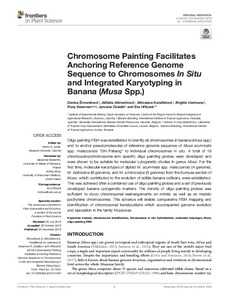
Chromosome painting facilitates anchoring reference genome sequence to chromosomes in situ and integrated karyotyping in banana (Musa spp.)
(2019)Oligo painting FISH was established to identify all chromosomes in banana (Musa spp.) and to anchor pseudomolecules of reference genome sequence of Musa acuminata spp. malaccensis “DH Pahang” to individual chromosomes in situ. A total of 19 chromosome/chromosome-arm specific oligo painting probes were developed and were shown to be suitable for molecular cytogenetic studies in genus Musa. For the first time, molecular karyotypes of diploid M. acuminata spp. malaccensis (A genome), M. balbisiana ... -
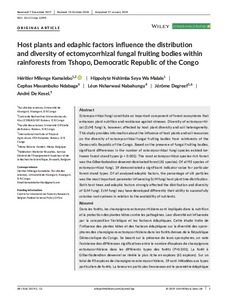
Host plants and edaphic factors influence the distribution and diversity of ectomycorrhizal fungal fruiting bodies within rainforests from Tshopo, Democratic Republic of the Congo
(2019)Ectomycorrhizal fungi constitute an important component of forest ecosystems that enhances plant nutrition and resistance against stresses. Diversity of ectomycorrhizal (EcM) fungi is, however, affected by host plant diversity and soil heterogeneity. This study provides information about the influence of host plants and soil resources on the diversity of ectomycorrhizal fungal fruiting bodies from rainforests of the Democratic Republic of the Congo. Based on the presence of fungal fruiting bodies, ... -
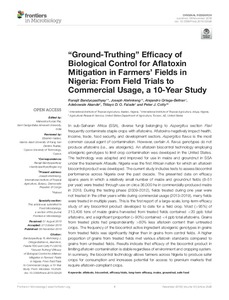
"Ground-truthing" efficacy of biological control for aflatoxin mitigation in farmers' fields in Nigeria: from field trials to commercial usage, a 10-year study
(2019)In sub-Saharan Africa (SSA), diverse fungi belonging to Aspergillus section Flavi frequently contaminate staple crops with aflatoxins. Aflatoxins negatively impact health, income, trade, food security, and development sectors. Aspergillus flavus is the most common causal agent of contamination. However, certain A. flavus genotypes do not produce aflatoxins (i.e., are atoxigenic). An aflatoxin biocontrol technology employing atoxigenic genotypes to limit crop contamination was developed in the ... -
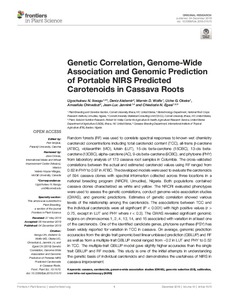
Genetic correlation, genome-wide association and genomic prediction of portable NIRS predicted carotenoids in cassava roots
(2019)Random forests (RF) was used to correlate spectral responses to known wet chemistry carotenoid concentrations including total carotenoid content (TCC), all-trans β-carotene (ATBC), violaxanthin (VIO), lutein (LUT), 15-cis beta-carotene (15CBC), 13-cis beta-carotene (13CBC), alpha-carotene (AC), 9-cis beta-carotene (9CBC), and phytoene (PHY) from laboratory analysis of 173 cassava root samples in Columbia. The cross-validated correlations between the actual and estimated carotenoid values using RF ... -
Food access deficiencies in sub-Saharan African: prevalence and implications for agricultural interventions
(2019)Our understanding of food security in sub-Saharan Africa (SSA) has been hampered by limitations in the temporal and spatial representativeness of data. Food balance sheets provide scalable estimates of per capita food availability, but fail to represent food access, stability and their causal linkages. In contrast, rural household surveys represent detailed conditions for one or multiple points in time, but are influenced by survey timing and are often limited in geographical coverage. This study ... -
Factors influencing participation dynamics in research for development interventions with multi-stakeholder platforms: a metric approach to studying stakeholder participation
(2019)Multi-stakeholder platforms have become mainstream in projects, programmes and policy interventions aiming to improve innovation and livelihoods systems, i.e. research for development interventions in low- and middle-income contexts. However, the evidence for multistakeholder platforms’ contribution to the performance of research for development interventions and their added value is not compelling. This paper focuses on stakeholder participation as one of the channels for multi-stakeholder ... -
Evaluation of the American yam bean (Pachyrhizus spp.) for storage root yield across varying eco-geographic conditions in Uganda
(2019)The American yam bean (Pachyrhizus spp.) is a legume crop that is exclusively used for its storage roots. The seeds are inedible due to presence of toxic rotenone. It produces high storage root yields comparable of major root crops like cassava or sweetpotato. And flower pruning more than doubles its root yield performance. Using twenty five yam bean accessions, the current study aimed to determine root yield stability and adaptability, and presence of yam bean production mega environments in ... -
Effectiveness of communication channels on level of awareness and determinants of adoption of improved common bean technologies among smallholder farmers in Tanzania
(Springer International Publishing, 2019)Increased legume productivity contributes to nutritional security as they are a source of cheap proteins. However, there is limited access to information on improved legume technologies among smallholder farmers in resource poor countries such as Tanzania. This chapter is aimed at assessing the effectiveness of communication channels (i.e. demonstration plots, farmer field days, technological briefs) on level of awareness and the determinants of adoption of improved common bean technologies among ... -
Distribution of Pseudocercospora species causing Sigatoka leaf diseases of banana in Uganda and Tanzania
(2020-01)Sigatoka leaf diseases are a major constraint to banana production. A survey was conducted in Tanzania and Uganda to assess the distribution of Pseudocercospora species and severity of Sigatoka leaf diseases. Pseudocercospora species were identified using species‐specific primers. Sigatoka‐like leaf diseases were observed in all farms and on all cultivars, but disease severity varied significantly (P < 0.001) between countries, districts/regions within countries, altitudinal ranges and banana ... -
Distribution and diversity of viruses infecting yams (Dioscorea spp.) in Cameroon
(2019-12)Yam (Dioscorea spp.) is an important food crop cultivated for its edible tubers in Cameroon. Surveys were conducted in Cameroon to determine the incidence and severity of yam mosaic disease and associated viruses in 124 yam farms in four agro-ecological zones in 2014 and 2016. Dioscorea rotundata, D. cayenensis, D. alata, D. Dumetorum and D. bulbifera were most frequently detected yam species in the fields. Symptoms of virus disease were observed on 81.5% of the farms surveyed and the disease ... -
Changes in heterosis of maize (Zea mays L.) varietal cross hybrids after four cycles of reciprocal recurrent selection
(2019)Two improved tropical maize composites, TZL COMP3 and TZL COMP4; representing complementary heterotic pools have been subjected to four cycles of reciprocal recurrent selection (RRS) for two decades to enhance varietal cross performance. The objectives of this study were to evaluate the effect of selection on genetic gain in heterosis for grain yield and other agronomic traits of these composites. Ten parental populations representing the C0 to C4 of each composite and their crosses plus a varietal ... -
Assessment of genetic diversity for drought, heat and combined drought and heat stress tolerance in early maturing maize landraces
(2019)Climate change is expected to aggravate the effects of drought, heat and combined drought and heat stresses. An important step in developing ‘climate smart’ maize varieties is to identify germplasm with good levels of tolerance to the abiotic stresses. The primary objective of this study was to identify landraces with combined high yield potential and desirable secondary traits under drought, heat and combined drought and heat stresses. Thirty-three landraces from Burkina Faso (6), Ghana (6) and ...