Welcome to the International Institute of Tropical Agriculture Research Repository
IITA Bibliography System: Recent submissions
Now showing items 521-540 of 8125
-
A review of the use of Near-Infrared Hyperspectral Imaging (NIR-HSI) techniques for the non-destructive quality assessment of root and tuber crops
(2023-04-22)Hyperspectral imaging (HSI) is one of the most often used techniques for rapid quality evaluation for various applications. It is a non-destructive technique that effectively evaluates the quality attributes of root and tuber crops, including yam and cassava, and their food products. Hyperspectral imaging technology, which combines spectroscopy and imaging principles, has an advantage over conventional spectroscopy due to its ability to simultaneously evaluate the physical characteristics and ... -
Perspective article: food security in tropical Africa through climate-smart plant health management
(2023)Each year, Africa loses half of its harvest to pests (insects, pathogens, nematodes, weeds). To offset these losses and improve food security, pest management needs to be revamped urgently. Based on a synthesis of all 58 pest management projects conducted by IITA in its 55-year history, we advocate here for the implementation of the five following key climate-smart interventions, which have been shown to increase yields and decreasing CO2 outputs compared to the current practices that are largely ... -
Pathogenicity of Beauveria bassiana (Balsamo-Crivelli) and Metarhizium anisopliae (Metschnikoff) isolates against life stages of Zeugodacus cucurbitae (Coquillett) (Diptera: Tephritidae)
(2023-04-25)Background Entomopathogenic fungi are primary pathogens that naturally affect insect pests by suppressing their populations and considered as an ecofriendly agents. The present study aimed to evaluate in vitro activity of different isolates of Beauveria bassiana and Metarhizium anisopliae against the development of larval stages of the Cucurbit fruit fly, Zeugodacus cucurbitae (Coquillett) (Diptera: Tephritidae). Results Larval mortality was significantly high with B. bassiana isolate Bb337 ... -
Narrowing yield gaps does not guarantee a living income from smallholder farming-an empirical study from western Kenya
(2023-04-20)Crop yields in sub-Saharan Africa need to increase to keep pace with food demands from the burgeoning population. Smallholder farmers play an important role in national food self-sufficiency, yet many live in poverty. Investing in inputs to increase yields is therefore often not viable for them. To investigate how to unlock this paradox, whole-farm experiments can reveal which incentives could increase farm production while also increasing household income. In this study we investigated the impact ... -
Assessing the skill of gridded satellite and re-analysis precipitation products over altitudinal gradient in east and southern Africa
(2023-04-06)Validation of gridded precipitation products (GPP's) increases the confidence of the users and highlights possible improvements in the algorithms to handle complex rain forming processes. We evaluated the skill of three GPP's (CHIRPS-v2, CHELSA, and TerraClimate) in estimating the gauge observations and compared the precipitation trends derived from these products across the East and Southern Africa (ESA) region. We used Taylor diagrams and Kling-Gupta Efficiency (KGE) to assess the accuracy. A ... -
Productivity of cowpea genotype under maize intercropping system in the northern and southern Guinea Savanna of Nigeria
(Bayero University Kano, 2020-02)A field experiment was conducted in 2018 rainy season at the International Institute of Agriculture Research Farms at Abuja and Zaria to know the adaptability of cowpea genotype to maize canopy in northern and southern Guinea savannah of Nigeria. The experiment consisted of 12 treatment combinations; of three cowpea varieties (SAMPEA 11, SAMPEA 14, and UAM09-126-19-2) in two cropping systems (sole and intercropped with EVDT99) and at two relay dates (5 and 8 WAS). The treatments were laid out in ... -
Quantifying leaf litter production, decomposition, and nutrient release in cacao plantations in southwest Nigeria
(University of Ibadan, 2021-10)Nutrient cycled from litterfall plays an important role in sustaining the fertility status in cacao (Theobroma cacao L.) plantations. However, the role of macrofauna in regulating the rate of decomposition and nutrient release remains uncertain despite its importance in litter decomposition and nutrient release. The study was carried out to assess the quantity and seasonal pattern of annual litterfall production in low-shade cacao plantations found in Southwestern Nigeria and also to determine the ... -
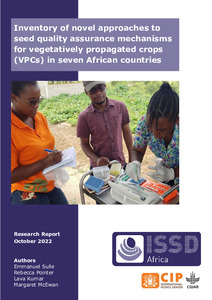
Inventory of novel approaches to seed quality assurance mechanisms for vegetatively propagated crops (VPCs) in seven African countries
(IInternational Institute of Tropical Agriculture, 2022-10)This paper provides an inventory of novel approaches to and mechanisms for quality assurance of the seeds of vegetatively produced crops (VPCs). It explores to what extent seven African countries (Ethiopia, Kenya, Malawi, Nigeria, Tanzania, Uganda and Zambia) are decentralising and integrating VPC seed systems, in terms of regulations governing the sector, methods of seed production, and methods of seed inspection and certification. It consolidates existing data and presents new data on decentralised ... -
Performances des techniques d'association mais-pois d'angole efficientes contre la Chenille Legionnaire Automne
(Entomological Society of the Republic of Benin, 2022-11)Au Bénin, la chenille légionnaire d’Automne (CLA), Spodoptera frugiperda est la principale contrainte à la production de maïs car ils peuvent entraîner une perte totale de rendement. L’association Maïs (M) /Pois d’Angole (PA) permettrait d’optimiser le service écosystémique et la gestion de ce ravageur. La présente recherche vise à évaluer les performances de cette association sur la réduction de l’infestation, et sur les dégâts de S. frugiperda. Ainsi, dans les trois catégories d’association (S0 ... -
Biological observations of Meromacroides meromacriformis (Bezzi, 1915) (Diptera: Syrphidae) in South Africa
(2022-09)Meromacroides meromacriformis (Bezzi, 1915) is an enigmatic hoverfly, first collected in South Africa in the 1850s, but not again until 2020. A further collection in 2022 was also made in the country. While widespread in Africa, the species is rarely encountered and information about its biology is scarce. The recent collections in South Africa were associated with colonies of Schedorhinotermes lamanianus (Isoptera: Rhinotermitidae) found in rot-holes within the trunk of a standing living trees ... -
Creating a lean, reliable, and scalable platform for highfrequency data on diet quality in Rwanda
(Global Alliance for Improved Nutrition, 2022) -
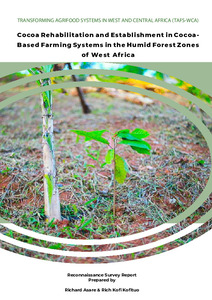
Cocoa rehabilitation and establishment in cocoa-based farming systems in the humid forest zones of west Africa
(IInternational Institute of Tropical Agriculture, 2022)The cocoa rehabilitation and establishment in cocoa-based farming systems in the humid forest zones of West Africa is part of the larger TAFS-WCA initiative that seeks to enhance access to quality, nutrient-dense seed, and climate-smart good agricultural practices (GAP) and reduced post-harvest losses and to see how these have a positive impact on food and nutrition and health security. Within the cocoa sector in West Africa, this initiative seeks to improve yields of cocoa and food crops and ... -
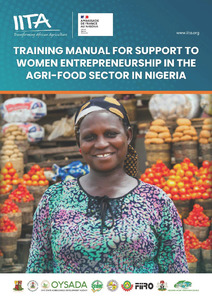
Training manual for support to women entreprenueurship in the agri-food sector in Nigeria
(2022)The paradigm shifts from a supply-driven intervention to a more responsive demand-drive intervention necessitates the fulfillment of the sociological approach. This approach advocates that the needs of beneficiaries be ascertained before any intervention is carried out. Consequently, the training needs of women agri-preneurs were identified in Ibadan and Zaria of Oyo and Kaduna states, respectively during the inception of the Support to Women Entrepreneurship in the Agrifood sector in Nigeria ... -
Framework for Incorporating Gender Equality and Social Inclusion (GESI) elements in Climate Information Services (CIS)
(2023-01)We advance a gender equality and social inclusion (GESI) framework for incorporating climate information services (CIS), which is now becoming central due to the ongoing climate change and climate variability. We understand gender as a social construct of who women and men are supposed to be. Gender inequalities seem to be enduring such that, despite innovations in agricultural and climate information technologies, unequal gender power dynamics will still emerge. As far back as the 1960s, the ... -
Agronomic and economic performance of legume-legume and cereal-legume intercropping systems in Northern Tanzania
(2023-02)CONTEXT Cereal-legume intercropping, a common practice among farmers in sub-Saharan Africa (SSA), is important for crop diversification, soil fertility improvement, household nutrition and climate adaptation. However, cereals often outcompete the intercropped legumes for growth resources resulting in low legume yields. OBJECTIVE The objectives of this study were: i) assessing the effects of different intercropping options (crop spatial configurations) and maize crop (Zea mays L.) management ... -
The effect of communication media on the uptake of agricultural innovations in selected states of Nigeria
(2022-09-21)Purpose Poor uptake of agricultural innovations on weed management practices is a major factor responsible for low productivity. This paper examines how communication media can help improve farmers’ adoption behaviour. Methodology A sample of 725 Nigerian cassava farmers, exposed to agricultural innovation on weed management practices from varying sources, were asked, through a structured questionnaire, to indicate their knowledge, attitudes, and practices of cassava weed management. The responses ... -
The banana genome hub: a community database for genomics in the Musaceae
(2022-01-05)The Banana Genome Hub provides centralized access for genome assemblies, annotations, and the extensive related omics resources available for bananas and banana relatives. A series of tools and unique interfaces are implemented to harness the potential of genomics in bananas, leveraging the power of comparative analysis, while recognizing the differences between datasets. Besides effective genomic tools like BLAST and the JBrowse genome browser, additional interfaces enable advanced gene search ... -
Assessing the host status of banana and other plant species to the enset root mealybug Paraputo ensete (Williams & Matile-Ferrero)(Hem.: Pseudococcidae) in Ethiopia
(2022-12-01)Ninety backyard gardens in the south-eastern Ethiopian highlands with enset (Ensete ventricosum (Welw.) Cheesman), banana and various annual crops were assessed for the presence of enset root mealybugs (Paraputo ensete (Williams & Matile-Ferrero)). This study presents the first observation of enset root mealybugs on banana. This pest has until now been exclusively recorded on enset in Ethiopia. In the Dilla Zuria district of the Gedeo zone, southern Ethiopia, infested banana mats of the ‘Pisang ... -
Epidemiological analysis of Cassava Mosaic and Brown Streak Diseases, and Bemisia tabaci in the Comoros Islands
(2022-09-30)A comprehensive assessment of cassava brown streak disease (CBSD) and cassava mosaic disease (CMD) was carried out in Comoros where cassava yield (5.7 t/ha) is significantly below the African average (8.6 t/ha) largely due to virus diseases. Observations from 66 sites across the Comoros Islands of Mwali, Ngazidja, and Ndzwani revealed that 83.3% of cassava fields had foliar symptoms of CBSD compared with 95.5% for CMD. Molecular diagnostics confirmed the presence of both cassava brown streak ... -
Evaluation of the efficacy of Flupyradifurone against Bemisia tabaci on cassava in Tanzania
(2022-10-12)A novel butenolide insecticide—flupyradifurone (Sivanto SL 200)—was evaluated for efficacy against cassava-colonizing Bemisia tabaci whitefly under laboratory, screenhouse and field conditions. LC50 values from leaf disc spray assays were comparable for both flupyradifurone (12.7 g a.i/100 L) and imidacloprid (12.6 g a.i/100 L). Both insecticides caused high levels of adult whitefly mortality in leaf disc and leaf dip assays when compared to untreated controls. In screenhouse-based trials, longer ...