Welcome to the International Institute of Tropical Agriculture Research Repository
IITA Bibliography System: Recent submissions
Now showing items 121-140 of 8125
-
Genomic prediction of the performance of tropical doubled haploid maize mines under artificial Striga hermonthica (Del.) Benth. infestation
(2024-08-12)Striga hermonthica (Del.) Benth., a parasitic weed, causes substantial yield losses in maize production in sub-Saharan Africa. Breeding for Striga resistance in maize is constrained by limited genetic diversity for Striga resistance within the elite germplasm and phenotyping capacity under artificial Striga infestation. Genomics-enabled approaches have the potential to accelerate identification of Striga resistant lines for hybrid development. The objectives of this study were to evaluate the ... -
Genetic diversity, linkage disequilibrium, and population structure in a common bean reference collection
(2024-05-08)An in-depth understanding of the extent and pattern of genetic diversity and population structure in crop populations is of paramount importance for any crop improvement program to efficiently promote the translation of genetic diversity into genetic gain. A reference collection of 150 common bean genotypes selected from the International Center for Tropical Agriculture’s global core collection was evaluated using single-nucleotide polymorphism (SNP) markers to quantify the amount of genetic ... -
Genetic diversity of whiteflies colonizing crops and their associated endosymbionts in three agroecological zones of Cameroon
(2024-08-30)Bemisia tabaci (Gennadius) is as a major pest of vegetable crops in Cameroon. These sap-sucking insects are the main vector of many viruses infecting plants, and several cryptic species have developed resistance against insecticides. Nevertheless, there is very little information about whitefly species on vegetable crops and the endosymbionts that infect them in Cameroon. Here, we investigated the genetic diversity of whiteflies and their frequency of infection by endosymbionts in Cameroon. ... -
A case of transdisciplinarity and collaborative decision making: the co-construction of Gendered Food Product Profiles
(2024-06)Crop breeding in sub-Saharan Africa has made considerable gains; however, postharvest and food-related preferences have been overlooked, in addition to how these preferences vary by gender, social difference and context. This context is changing as participatory approaches using intersectional gender and place-based methods are beginning to inform how breeding programmes make decisions. This article presents an innovative methodology to inclusively and democratically prioritise food quality traits ... -
Modeling integrated soil fertility management for maize production in Kenya using a Bayesian calibration of the DayCent model
(2024-08-22)Sustainable intensification schemes such as integrated soil fertility management (ISFM) are a proposed strategy to close yield gaps, increase soil fertility, and achieve food security in sub-Saharan Africa. Biogeochemical models such as DayCent can assess their potential at larger scales, but these models need to be calibrated to new environments and rigorously tested for accuracy. Here, we present a Bayesian calibration of DayCent, using data from four long-term field experiments in Kenya in a ... -
FAIRscribe user manual
(Excellence in Agronomy Initiative, 2024-09) -
A review of gender equality and social inclusion issues in Zambia’s agribusiness ecosystem
(International Institute of Tropical Agriculture, 2024-08) -
First evidence on the occurrence of multi‑mycotoxins and dietary risk exposure to AFB1 along the cassava value chain in Uganda
(2024-09-17)This study investigated the occurrence and distribution of multiple mycotoxins (aflatoxin B1, B2, G1, G2, feminizing B1, B2, ochratoxin A (OTA), deoxynivalenol (DON), zearalenone (ZEN), and citrinin (CIT)) in cassava products and as assessed the potential risk of aflatoxin B1 (AFB1) exposure among cassava consumers. A total of 192 samples of Cassava products (96 four and 96 chips, each with 48 samples from farmer and 48 from wholesaler) were analyzed using LC/MS–MS. All positive samples irrespective ... -
Diversity studies in 21 maize (Zea mays L.) accessions based on agro-morphological characters and diversity array technology (DArTs)
(Federal University of Agriculture Abeokuta, 2023-03)Maize (Zea mays L.) is one of the most important crops in the world, being among the main sources of human food, animal feed, and industrial raw material. Landraces have certain genetic integrity, which is recognizable morphologically and by farmers. Maize grain yield is influenced by environmental conditions that can either boost production or retard its development, hence the need to determine the enormous genetic diversity in maize and identify accessions with good adaptability in contrasting ... -
Framing behaviour change for sustainable agriculture: themes, approaches, and future directions
(2025-01)Despite the growing demand for behaviour change research and the benefit of understanding how human behaviour influences use cases and the adoption of agricultural innovations, research on how behaviour change occurs and the state of knowledge in the field remains scarce. To address this concern, this study conducted a systematic literature review of behaviour change in sustainable agriculture between 2015 and 2024. Our search identified 568 studies. After careful evaluation, 74 primary studies ... -
Crop calendar optimization for climate change adaptation in yam farming in South- Kivu, eastern D.R. Congo
(2024-09-04)The traditional crop calendar for yam (Dioscorea spp.) in South-Kivu, eastern Democratic Republic of Congo (DRC), is becoming increasingly inadequate given the significant climatic variability observed over the last three decades. This study aimed at: (i) assessing trends in weather data across time and space to ascertain climate change, and (ii) optimizing the yam crop calendar for various South-Kivu agro-ecological zones (AEZs) to adapt to the changing climate. The 1990–2022 weather data series ... -
Impact of storage conditions on the shelf life of aflatoxin biocontrol products containing atoxigenic isolates of Aspergillus favus as active ingredient applied in various countries in Africa
(2024-09-10)Aflatoxin contamination significantly threatens food safety and security, particularly in tropical and sub-tropical regions where staple crops such as maize, groundnut, and sorghum become frequently affected. This contamination is primarily caused by the fungus Aspergillus favus. The contamination causes adverse health effects, reduced income, and trade restrictions. In response to this challenge, various technologies have been developed to mitigate the impacts of aflatoxin. Among these, biocontrol ... -
Native arbuscular mycorrhizal fungi promote Plukenetia volubilis growth and decrease the infection levels of Meloidogyne incognita
(2024-06-27)The use of arbuscular mycorrhizal fungi (AMF) offers promising benefits to agriculture in the Amazon regions, where soils are characteristically acidic and nutrient-poor. The purpose of this research was to investigate the potential effects of two recently described species of AMF (Nanoglomus plukenetiae and Rhizoglomus variabile) native to the Peruvian Amazon for improving the plant growth of Plukenetia volubilis (inka nut or sacha inchi) and protecting the roots against soil pathogens. Two assays ... -
Etude de la possibilite de modelisation de la pate a pain a partir de la farine d'Ipomea batatas ou patate douce a chair blanche et a peau blanche
(l'Alliance Francaise d'Antsiranana, 2023-12-11)La farine de blé est la matière première la plus utilisée dans les différentes préparations des pâtes alimentaires en particulier, des pâtes à pains. Pourtant, son importation devient donc très onéreuse surtout pour les pays non producteurs. En conséquence, les coûts de production et le prix des produits de boulangerie sont devenus très chères. Or, Madagascar présente des ressources agricoles abondantes et variées qu’on peut transformer en farine y compris la patate douce (Ipomea batatas). Mais, ... -
Designing gender- and youth-responsive agronomic solutions: accelerating the use of digital tools for delivering agronomic advice through a public-private partnership extension model in Rwanda
(International Institute of Tropical Agriculture, 2024-07)This report is part of a study series offering insights into the potential of Excellence in Agronomy (EiA) Use Cases to adjust the agronomic solutions offered through the Minimum Viable Products (MVP) to better reach, benefit, and empower women and youths, and to transform norms that cause gender and social inequalities. These efforts are guided appropriately by the Reach-Benefit-Empower-Transform framework that highlights the importance of not only reaching women and young people, but also making ... -
Occurrence and distribution of major cassava pests and diseases in cultivated cassava varieties in western Kenya
(2024-09-15)Cassava is an important food crop in western Kenya, yet its production is challenged by pests and diseases that require routine monitoring to guide development and deployment of control strategies. Field surveys were conducted in 2022 and 2023 to determine the prevalence, incidence and severity of cassava mosaic disease (CMD) and cassava brown streak disease (CBSD), whitefly numbers and incidence of cassava green mite (CGM) in six counties of western Kenya. Details of the encountered cassava ... -
Climate-resilient aquatic food systems require transformative change to address gender and intersectional inequalities
(2024-07-16)The adverse impacts of climate change on aquatic food systems (AFS) and the people who depend on AFS for livelihood security are inequitably distributed between and within countries. People facing the highest risks and experiencing the severest impacts of climate change are those who already experience multidimensional inequalities in their lives, particularly because of their gender, class, age, indigeneity, ethnicity, caste, religion, and the physical and political conditions that can create ... -
Assessing the carotenoid profiles and allelic diversity of yellow maize inbred lines adapted to mid-altitude subhumid maize agroecology in Ethiopia
(2024-07-23)Biofortification of provitamin A in maize is an attractive and sustainable remedy to the problem of vitamin A deficiency in developing countries. The utilization of molecular markers represents a promising avenue to facilitate the development of provitamin A (PVA)-enriched maize varieties. We screened 752 diverse tropical yellow/orange maize lines using kompetitive allele-specific PCR (KASP) makers to validate the use of KASP markers in PVA maize breeding. To this end, a total of 161 yellow/orange ... -
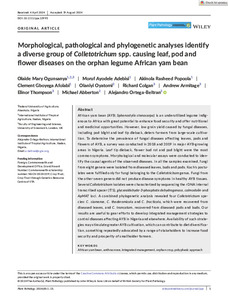
Morphological, pathological and phylogenetic analyses identify a diverse group of Colletotrichum spp. causing leaf, pod and flower diseases on the orphan legume African yam bean
(2024-09-02)African yam bean (AYB; Sphenostylis stenocarpa) is an underutilized legume indigenous to Africa with great potential to enhance food security and offer nutritional and medicinal opportunities. However, low grain yield caused by fungal diseases, including pod blight and leaf tip dieback, deters farmers from large‐scale cultivation. To determine the prevalence of fungal diseases affecting leaves, pods and flowers of AYB, a survey was conducted in 2018 and 2019 in major AYB‐growing areas in Nigeria. ... -
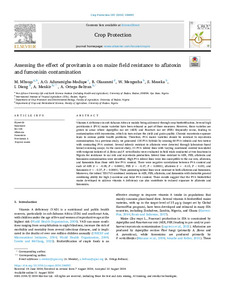
Assessing the effect of provitamin a on maize field resistance to aflatoxin and fumonisin contamination
(2024-11)Vitamin A deficiency in sub-Saharan Africa is mainly being addressed through crop biofortification. Several high provitamin A (PVA) maize varieties have been released as part of these measures. However, these varieties are grown in areas where Aspergillus ear rot (AER) and Fusarium ear rot (FER) frequently occur, leading to contamination with mycotoxins, which in turn reduce the yield and grain quality. Chronic mycotoxin exposure leads to serious public health problems. Therefore, PVA maize varieties ...