Welcome to the International Institute of Tropical Agriculture Research Repository
IITA Bibliography System: Recent submissions
Now showing items 1421-1440 of 8125
-
Cytological and molecular characterization for ploidy determination in yams (Dioscorea spp.)
(2021)Yam (Dioscorea spp.) is a monocotyledonous herbaceous vine plant grown in the tropics and subtropics. It is a multi-species plant with varied intra- and interspecific ploidy levels. Of the 600 species, 11 are cultivated supporting the livelihood of over 300 million people. The paucity of information on ploidy and the genomic constitution is a significant challenge to the crop’s genetic improvement through crossbreeding. The objective of this study was to investigate the ploidy levels of 236 ... -
Combining ability and heterotic grouping of turcicum-resistant early-maturing maize inbreds
(2021)Maize (Zea mays L.), an important source of calories and nutrients in sub-Saharan Africa, is threatened by northern corn leaf blight (NCLB) caused by Exserohilum turcicum. This study examined combining ability and heterotic patterns of early-maturing maize inbreds, gene action conditioning NCLB resistance, and performance of derived hybrids across environments and identified testers. Fifteen each of white and yellow inbreds were intercrossed using North Carolina Design II to obtain 75 hybrids per ... -
Are landscape restoration interventions sustainable? A case for the upper Tana Basin of Kenya
(2021)Landscape restoration initiatives often have the potential to result in environmental gains, but the question of whether these gains are sustainable and how they are linked to other community needs (social, productivity and economic gains) remains unclear. We use the Sustainable Intensification Assessment Framework (SIAF) to demonstrate how environmental benefits are linked to productivity, environment, social, human, and economic components. Using the SIAF, the standardization of relevant indicators ... -
Consumer preferences and socioeconomic factors decided on plantain and plantain-based products in the central region of Cameroon and Oyo state, Nigeria
(2021)Plantain is a key staple food in Central and West Africa, but there is limited understanding of its market in Africa. In addition, the cooking methods for enhancing the nutritional value, consumer preference, and willingness to pay for plantain and plantain-based products are not well understood. The knowledge gaps in the market and consumer dimension of the food chain need to be known to increase plantain utilization and guide breeding efforts. This research contributes by examining the cooking ... -
Collection, genotyping and virus elimination of cassava landraces from Tanzania and documentation of farmer knowledge
(2021)Cassava (Manihot esculenta Crantz.) has been a vital staple and food security crop in Tanzania for several centuries, and it is likely that its resilience will play a key role in mitigating livelihood insecurities arising from climate change. The sector is dominated by smallholder farmers growing traditional landrace varieties. A recent surge in virus diseases and awareness in the commercial potential of cassava has prompted a drive to disseminate improved varieties in the country. These factors ... -
Increasing cassava root yield on farmers’ fields in Nigeria through appropriate weed management
(2021)Weed competition is the major biological stress affecting cassava production in smallholder farms in West and Central Africa, where yields are low compared with those in Asia and Latin America. Options for improved weed management are crucial in increasing productivity. Selected pre- and post-emergence herbicides, integrated with appropriate tillage and plant spacing, were tested in 96 sites in four locations in Nigeria, 24 in 2016 and 72 in 2017. Trials were split plots with six pre-emergence ... -
Acibenzolar-S-methyl induces resistance against cassava mosaic geminiviruses in Nicotiana benthamiana and their vector Bemisia tabaci in cassava (Manihot esculenta)
(2021-12)Cassava mosaic disease (CMD), caused by cassava mosaic geminiviruses (CMGs), is a major constraint to the cassava crop in Africa and southeastern Asia. Here, we investigated the ability of acibenzolar-S-methyl (ASM), a functional analog of salicylic acid (SA), to trigger systemic acquired resistance (SAR) against two CMGs, namely African cassava mosaic virus (ACMV) and East African cassava mosaic Cameroon virus (EACMCV) in Nicotiana benthamiana. ASM treatment delayed the time to first viral symptoms ... -
Effects of pressure and temperature on the physico‑chemical properties and acrylamide formation of starchy banana chips during the post‑frying centrifuge step
(2021)The effects of pressure (21.3, 41.3, 61.3, 81.3, and 101.3 kPa) and temperature (174–184 °C) applied during the post-frying centrifuge stage on the physico-chemical characteristics of atmospheric fried plantain chips were studied. Results showed that the surface temperature dropped very fast during the cooling process while the total oil content gradually increased. The oil uptake in the plantain chips increased by 7.7% after 9 min of post-frying cooling. Though an alteration in moisture and oil ... -
Data on assessment of flours from advanced genotypes and improved cassava varieties for industrial applications
(2021)The data presented in this article are related to the research paper “Physicochemical parameters and functional properties of flours from advanced genotypes and improved cassava varieties for industrial applications” [1]. The genotypes were collected from a multi-location (Uniform yield Trial) trial of the IITA breeding program in Malawi. The data were obtained using multiple analytical techniques and methodology such as oven-drying, sieving, colorimetry, titration, acid hydrolysis method, the ... -
Strategies to combat the problem of yam anthracnose disease: status and prospects
(2021-10)Yam (Dioscorea spp.) anthracnose, caused by Colletotrichum alatae, is the most devastating fungal disease of yam in West Africa, leading to 50%–90% of tuber yield losses in severe cases. In some instances, plants die without producing any tubers or each shoot may produce several small tubers before it dies if the disease strikes early. C. alatae affects all parts of the yam plant at all stages of development, including leaves, stems, tubers, and seeds of yams, and it is highly prevalent in the yam ... -
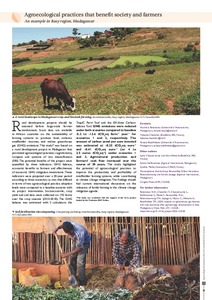
Agroecological practices that benefit society and farmers: an example in Itasy region, Madagascar
(Agropolis International, 2021-09) -
Integrating the soybean‑maize‑chicken value chains to attain nutritious diets in Tanzania
(2021)In Tanzania, diets are dominated by starchy staple crops such as maize, levels of malnutrition are high and largely attributed to lack of dietary diversity. We employed fuzzy cognitive mapping to understand the current soybean, maize and chicken value chains, to highlight stakeholder relationships and to identify entry points for value chain integration to support nutritious diets in Tanzania. The fuzzy cognitive maps were constructed based on information gathered during household interviews with ... -
Grain yield gains and associated traits in tropical x temperate maize germplasm under high and low plant density
(2021-09)Development of ideal breeding and crop management strategies that can improve maize grain yield under tropical environments is crucial. In the temperate regions, such yield improvements were achieved through use of genotypes that adapt high plant population density stress. However, tropical germplasm has poor tolerance to high plant population density stress, and thus it should be improved by temperate maize. The aim of this study was to estimate the genetic gains and identify traits associated ... -
Redesigning agroecosystems on the basis of a new set of ecological processes from farm and landscape
(Agropolis International, 2021) -
Substituting intensive external input use by biodiversity-derived ecosystem functions
(Agropolis International, 2021) -
Agroecological transformation for sustainable food systems: insight on France-CGIAR research
(Agropolis International, 2021) -
Does cooperative membership increase and accelerate agricultural technology adoption? Empirical evidence from Zambia
(2020)In developing countries, agricultural cooperatives are increasingly being used to promote improved agricultural technologies and alleviate food insecurity and poverty. However, little is known about the role of agricultural cooperatives in accelerating the adoption of improved agricultural technologies. Using a comprehensive balanced household panel and varietal data, this study applied the difference-in-difference model to identify factors affecting farmers’ decision to become cooperative members ...