Welcome to the International Institute of Tropical Agriculture Research Repository
IITA Bibliography System: Recent submissions
Now showing items 301-320 of 8125
-
Usindikaji wa muhogo baada ya kuvuna
(International Institute of Tropical Agriculture, 2023-11) -
Agricultural transformation in maize producing areas of Africa
(IntechOpen, 2024-01)Maize is a critical staple cereal across Sub-Saharan Africa but attempts to improve its productivity in small-scale farming systems often prove disappointing. The 12 key technologies required to overcome poor yields are mostly known, but the manner that they are mobilized, packaged, and delivered requires re-evaluation. Combinations of better varieties and their necessary accompanying inputs must become more available and affordable for an African maize revolution to succeed, and land must be ... -
Gender and youth assessment: enumerators manual
(IInternational Institute of Tropical Agriculture, 2023-12) -
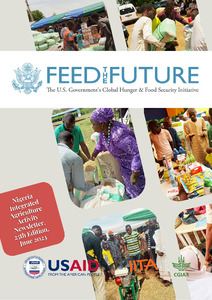
Feed the Future: Nigeria Integrated Agriculture Activity - 25th Edition
(United States Government, 2023-06) -
Rhizoglomus variabile and Nanoglomus plukenetiae, native to Peru, promote coffee growth in Western Amazonia
(2023-11-29)Coffee (Coffea arabica) is among the world’s most economically important crops. Coffee was shown to be highly dependent on arbuscular mycorrhizal fungi (AMF) in traditionally managed coffee plantations in the tropics. The objective of this study was to assess AMF species richness in coffee plantations of four provinces in Perú, to isolate AMF isolates native to these provinces, and to test the effects of selected indigenous AMF strains on coffee growth. AMF species were identified by morphological ... -
Morphometric diversity of some Nigerian accessions of Bambara groundnut (Vigna subterranea)
(2023)This study evaluated the morphological diversity of some Nigerian accessions of Bambara groundnut. Field experiments were conducted in Nigeria in two locations and the phenotypic variation of Bambara groundnut accessions evaluated in 3 years (2017–2020) using a randomized complete block design. Twenty-eight quantitative and 10 qualitative traits were observed. Twenty-three out of the 28 quantitative morphological traits showed significant differences. TVSu-589 (28.85) and TVSu-670 (28.57) had the ... -
Heterogeneity in arbuscular mycorrhizal fungi and plant communities of the Brazilian Cerrado, transitional areas toward the Caatinga, and the Atlantic forest
(2024-01-08)The Cerrado is the most diverse tropical savanna worldwide and the second-largest biome in South America. The objective of this study was to understand the heterogeneity and dynamics of arbuscular mycorrhizal fungi (AMF) in different types of natural Cerrado vegetation and areas that are transitioning to dryer savannas or tropical rainforests and to elucidate the driving factors responsible for the differences between these ecosystems. Twenty-one natural sites were investigated, including typical ... -
Sources of genetic resistance to Fusarium wilt (Fusarium oxysporum f. sp tracheiphilum) in cowpea (Vigna unguiculata (L.) Walp.) and comparison of inoculum concentration levels
(2023-12-09)Fusarium wilt caused by Fusarium oxysporum f. sp tracheiphilum (Fot) is a soil-borne fungal disease of significant constraint to cowpea production in West Africa. The disease infection can cause up to 100% yield loss in highly infested fields. The most effective control strategy is the use of resistant varieties. Sixty cowpea germplasm collections were screened for resistance to F. oxysporum. The result revealed that only two (TVu 134 and TVu 410) of the germplasm showed a high level of resistance ... -
SNP-based marker-assisted selection for high provitamin A content in African cassava genetic background
(2023-12)Vitamin A deficiency (VAD) contributes to significant levels of mortality and morbidity, particularly among children and women in Africa. Cassava is a major staple crop whose biofortification with beta-carotene can contribute to reducing the VAD prevalence in a cost-effective and sustainable approach. Developing high provitamin A content (pVAC) cassava varieties through the conventional approach is a laborious and slow process, partly due to the breeding bottlenecks caused by the biology of the ... -
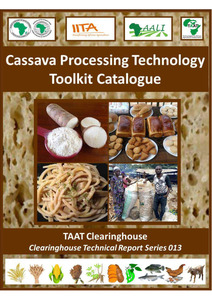
Cassava processing technology toolkit catalogue
(Technologies for African Agricultural Transformation, 2022-05)The purpose of this technology catalogue is to advance high quality cassava flour (HQCF) as a substitute for wheat in Africa. While Africa has the potential to increase its wheat production, it appears to be small in proportion to the massive demand for imported wheat. For example, Africa imported US $11 billion from eight European and North American countries in 2020, a massive expenditure of foreign reserves that could be better directed toward longer-term development goals. At the same time, ... -
Data-driven Advisories: AgWise for potato in Rwanda
(IInternational Institute of Tropical Agriculture, 2023) -
Socioeconomic effects of Oyo state government COVID-19 palliatives on poultry farmers
(2023)This study interviewed 349 poultry farmers that benefited from government poultry feed input palliatives meant to help them to contain the negative effects of COVID-19 of hunger, food insecurity, and poverty. Demographic results revealed that both males and females are involved in poultry farming; the average age of poultry farmers was 45 years, with an average family size of five. The average years of education were 13, equivalent to JSS 3 in the Nigerian education system. Types of poultry show ... -
Varietal diversity as a lever for cassava variety development: exploring varietal complementarities in Cameroon
(2023)BACKGROUND: Cassava is an important crop for the survival of smallholder farmers in Cameroon. However, the cassava sector has a low production per unit area compared to the technological potential in this country. In this context, breeders have developed varieties based mainly on their potential in terms of yield and disease resistance. These varieties have been widely disseminated in Cameroon within the framework of development projects. However, these releases have not achieved the expected ... -
Seasonal abundance of Paracoccus marginatus (Williams and Granara de Willink) (Hemiptera: Pseudococcidae) and damage to papaya seedlings in three agroecological zones in Southwestern Nigeria
(2021)The Papaya Mealybug, Paracoccus marginatus Williams and Granara de Willink, is an invasive species. The abundance of the papaya mealy bug and its damage to seedlings were investigated in the field at three agro-ecological zones: which includes Akure (Rainforest), Ogbomoso (Guinea savannah), Ibadan (Derived savannah) in the 2016 growing seasons. At each site, 10 healthy mother plants with fruit (> 17cm GBH) were randomly selected from which five infested and non-infested leaves (fifth to the 13th ... -
Identification of diagnostic KASP-SNP markers for routine breeding activities in yam (Dioscorea spp.)
(2023)Maintaining genetic purity and true-to-type clone identification are important action steps in breeding programs. This study aimed to develop a universal set of kompetitive allele-specific polymerase chain reaction (KASP)-based single nucleotide polymorphism (SNP) markers for routine breeding activities. Ultra-low-density SNP markers were created using an initial set of 173,675 SNPs that were obtained from whole-genome resequencing of 333 diverse white Guinea yam (Dioscorea rotundata Poir) genotypes. ... -
Hydroxamic acids: New players in the multifactorial mechanisms of maize resistance to Striga hermonthica
(2023-11)Striga hermonthica is the most widespread and destructive plant parasite infesting maize and other major crops in sub-Saharan Africa where it causes severe yield losses and threatens food security. Several tolerant maize lines supporting reduced S. hermonthica emergence have been deployed. However, the molecular bases of such resistance are yet poorly understood. Based on a time course comparative gene expression analysis between susceptible and resistant maize lines we have confirmed resistance ... -
Adaptive Research Programme: Technical Report No. 3
(North West Development Authority, Cameroon, 1988) -
Prioritizing preferred traits in the yam value chain in Nigeria: a gender situation analysis
(2023-11-13)This study describes what did and did not work in the prioritization of preferred traits within the value chain of yam and associated food products (boiled and pounded yam) in Nigeria. Demand-led breeding protocols have enhanced participatory methods along gender lines to increase the clarity of information on the yam traits preferred by farmers and other end users. Drawing on the experience of the cross-cutting gender team at the National Root Crops Research Institute (NRCRI), Umudike, and partners, ... -
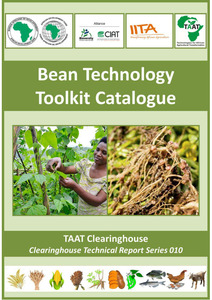
Bean technology toolkit catalogue: clearinghouse technical report series 010
(Technologies for African Agricultural Transformation, 2021-10) -
Evaluation of genotypic variability and analysis of yield and its components in irrigated rice to stabilize yields in the Senegal river valley affected by climate change
(2023)Rice is an important cereal crop in many countries, but its production in the Senegal River Valley is hampered by adverse climatic conditions. This study was aimed at evaluating the diversity among genotypes and the association between several phenological and yield attributes of irrigated rice to mitigate the consequences of climate change. During the dry season of 2013–2014, 300 irrigated high yielding oryza sativa indica panel were used in an Alpha-lattice experiment at the Ndiaye research ...